
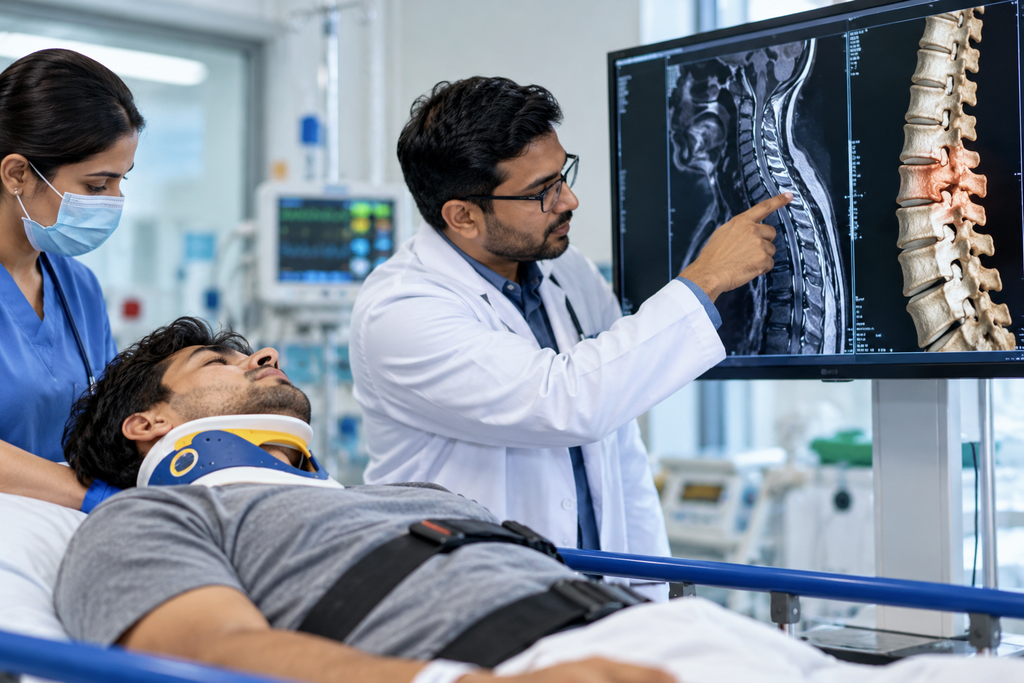
A sudden accident a road collision, a fall from height, or a sports injury can leave anyone worried about their spine. Even when a person seems to walk away with only minor discomfort, the possibility of a hidden spinal injury makes proper medical assessment essential. The spine protects the spinal cord, the delicate bundle of nerves that carries signals between the brain and the rest of the body. Damage to this structure can have lasting consequences if not identified and managed promptly. what diagnostic tools they use, which symptoms demand emergency attention, and how spinal injuries are evaluated in children and adolescents. It is intended for patients, parents, and caregivers who want to understand the process of spinal trauma evaluation and the importance of timely spinal treatment in Bhubaneswar and other specialized centers
What Is Spine Trauma?
The spine is a column of bones (vertebrae) stacked from the neck to the lower back. Between the vertebrae are discs that cushion movement, and behind them runs the spinal canal, which houses the spinal cord and nerve roots. Spine trauma refers to any injury to these structures caused by an external force.
Doctors distinguish between two broad categories:
- Spinal column injuries: Damage to the bones (fractures), joints (dislocations), or ligaments of the spine. These may or may not involve the spinal cord.
- Spinal cord injuries: Damage to the spinal cord itself, which can cause weakness, numbness, loss of sensation, or paralysis below the level of injury.
Traumatic spinal injuries can include fractures, dislocations, ligament tears, and spinal cord compression or contusion. They may affect the cervical spine (neck), thoracic spine (upper back), or lumbar spine (lower back), with cervical injuries being particularly common in trauma.
What Causes Spinal Injuries After an Accident?
Spinal trauma can result from a range of events. Common causes include:
- Road traffic accidents — high-speed collisions, especially involving motorcycles or bicycles
- Falls from heights — ladders, rooftops, windows, or stairs
- Sports-related collisions — contact sports, diving accidents, or falls during play
- Bicycle and motorcycle accidents — even at moderate speeds
- Heavy objects striking the back
- Accidents involving children — playground falls, vehicle collisions, or sports injuries
Not every accident causes spinal trauma. However, the mechanism of injury how the accident happened helps doctors decide how urgently to investigate.
What Are the Warning Signs of a Spinal Injury?
Symptoms of a spinal injury can vary widely. Some people have obvious pain or neurological problems, while others may have subtle findings. Possible warning signs include:
- Neck or back pain after trauma
- Tenderness along the spine, especially in the midline
- Weakness or numbness in the arms or legs
- Tingling or altered sensation in the limbs
- Difficulty moving or walking
- Loss of coordination
- Changes in bladder or bowel control
- Difficulty breathing (in severe cervical injuries)
Crucially, the absence of pain does not reliably exclude a serious injury. Some spinal injuries, particularly in children, may present with minimal initial symptoms. This is why clinical assessment is necessary after significant trauma.
When Is a Spinal Injury an Emergency?
Immediate emergency care is required when a serious spinal injury is suspected. This is particularly true after high-impact accidents or when any neurological symptoms are present.
Safety guidance for suspected spinal injury:
- Call local emergency services immediately.
- Do not ask the injured person to stand, walk, twist, or move unnecessarily.
- Do not attempt to straighten the neck or back.
- Follow emergency professionals’ instructions and avoid unnecessary movement while awaiting help.
Emergency medical teams are trained to immobilize the spine appropriately and transport the patient safely.
How Do Doctors Assess Spine Trauma After an Accident?
The assessment of suspected spinal trauma follows a structured, step-by-step approach. This ensures that life-threatening conditions are addressed first and that the spine is evaluated safely.
1. Reviewing the Accident History
Doctors begin by asking detailed questions about how the injury occurred. They want to understand the mechanism of injury — the height of a fall, the speed of a vehicle, whether the person was restrained, and whether there was any loss of consciousness. They also ask about when symptoms started, whether pain or numbness has changed over time, and whether the person has any pre-existing spinal conditions.
2. Initial Medical Assessment
In emergency settings, clinicians follow a protocol known as Advanced Trauma Life Support (ATLS) , which prioritizes airway, breathing, circulation, disability, and exposure. Life-threatening injuries are addressed before a detailed spinal evaluation. During this phase, the cervical spine is protected with manual in-line stabilization until a formal assessment is completed.
3. Physical Examination
Once the patient is stabilized, doctors perform a focused physical examination. This includes:
- Palpation of the spine to check for midline tenderness or deformity
- Assessment of range of motion, but only when it is safe to do so. If injury is suspected, the neck is not moved further.
- Examination of the limbs for movement, sensation, and reflexes
- Checking for other injuries that may distract from spinal assessment
4. Neurological Assessment
A neurological examination helps determine whether the spinal cord or nerve roots are involved. Doctors assess:
- Motor function — strength in the arms and legs
- Sensory function — ability to feel light touch, pinprick, or vibration
- Reflexes — including deep tendon reflexes
- Bladder and bowel function — relevant when spinal cord involvement is suspected
5. Diagnostic Imaging
Imaging plays a central role in spinal trauma evaluation, but the choice of test depends on the clinical findings, the patient’s age, and the mechanism of injury. Not every patient requires every test.
- X-rays: May identify certain fractures or alignment abnormalities, but they are less sensitive than CT for detecting spinal injuries in high-risk patients.
- CT scans: The preferred imaging modality for evaluating traumatic fractures and detailed bone injuries in adults. CT is highly sensitive for detecting bony injuries and is often used as the first-line investigation in moderate-to-high-risk cases.
- MRI scans: Used to assess the spinal cord, discs, ligaments, nerves, and other soft tissues. MRI is particularly important when neurological deficits are present despite normal CT findings, or when ligamentous injury is suspected.
The decision to use imaging and which type follows established clinical decision rules such as the NEXUS criteria or the Canadian C-Spine Rule in adults. For those requiring advanced spinal treatment in Bhubaneswar, these imaging protocols guide the treatment plan.
How Is Spine Trauma Assessed in Children?
Spinal assessment in children differs from adults for several important reasons. Children have:
- Larger heads relative to their bodies, which shifts the biomechanics of neck injury
- More elastic spinal ligaments, allowing greater deformation without fracture
- Growth plates that are still developing
- Greater sensitivity to radiation from CT scans
Because of these differences, doctors use pediatric-specific clinical decision rules to guide imaging. The PECARN cervical spine injury prediction rule, for example, helps identify children at high risk who need imaging and those at low risk who can be clinically cleared without radiation exposure.
For children, the assessment emphasizes:
- Age-appropriate communication and examination
- Careful interpretation of symptoms — children may not describe pain or numbness accurately
- Consideration of radiation exposure — MRI may be preferred over CT in certain cases
- Awareness of conditions that predispose to spinal instability, such as Down syndrome or juvenile idiopathic arthritis
Suspected spinal trauma in a child requires prompt professional assessment. Do not delay evaluation because symptoms seem mild. A Pediatric Orthopedic Surgeon can provide specialized evaluation for children with spine and musculoskeletal concerns.
What Happens After Doctors Identify a Spinal Injury?
Treatment depends on the type and severity of the injury. Options may include:
- Observation and pain management for selected minor injuries
- A brace or other immobilization when clinically indicated to protect the spine during healing
- Specialist monitoring and rehabilitation for neurological recovery
- Surgery for certain unstable fractures, spinal cord compression, or injuries requiring operative stabilization
Treatment decisions are individualized and are made by the appropriate medical team based on the specific injury and the patient’s overall condition. For complex cases, spinal treatment may involve a multidisciplinary team including orthopedic surgeons, neurosurgeons, and rehabilitation specialists.
Frequently Asked Questions
1. How do doctors check for spinal injuries after an accident?
Ans :- Doctors review the accident history, perform a physical examination, assess neurological function, and use imaging tests such as X-rays, CT scans, or MRI when indicated.
2. Can a spinal injury occur without severe pain?
Ans :- Yes. Some spinal injuries, particularly certain ligamentous injuries or spinal cord conditions, may cause minimal initial pain.
3. Which scan is best for detecting spinal trauma?
Ans :- CT is generally preferred for detecting bony injuries in adults. MRI is the gold standard for evaluating the spinal cord, ligaments, and soft tissues. The choice depends on the clinical situation and suspected injury type.
4. Is an X-ray enough to rule out a spinal injury?
Ans :- Not always. X-rays can miss certain fractures and ligamentous injuries. In high-risk patients, CT or MRI may be necessary for a complete evaluation.
5. When is an MRI needed after a back injury?
Ans :- MRI is typically indicated when neurological deficits are present despite normal CT findings, when ligamentous injury is suspected, or when spinal cord involvement needs assessment.
6. What are the warning signs of spinal cord damage?
Ans :- Warning signs include weakness or numbness in the limbs, difficulty walking, loss of coordination, and changes in bladder or bowel control. Severe neck injuries may also affect breathing.
7. How are spinal injuries assessed in children?
Ans :- Children are assessed using age-appropriate examination techniques and pediatric-specific clinical decision rules.
8. Should someone with a suspected spinal injury be moved?
Ans :- No , Do not move someone with a suspected spinal injury unless they are in immediate danger. Call emergency services and follow their instructions.
9. Can spinal injury symptoms appear hours after an accident?
Ans :- Yes. Some symptoms, particularly neurological ones, may develop or worsen over time. Seek urgent medical attention if new symptoms appear after an accident.
10. When should a child see a pediatric orthopedic specialist after an accident?
Ans :- A pediatric orthopedic consultation may be appropriate for ongoing evaluation of a diagnosed or suspected musculoskeletal injury that does not require emergency care. For suspected serious spinal trauma, seek emergency assessment first. For advanced spinal treatment in Bhubaneswar, consult a qualified spine specialist.
Conclusion
Spinal trauma after an accident requires careful, timely assessment. Doctors use a structured approach that begins with stabilizing the patient, reviewing the mechanism of injury, performing physical and neurological examinations, and selecting appropriate imaging based on clinical findings. In children, assessment is adapted to their unique anatomy and radiation sensitivity. If you suspect a spinal injury after an accident, seek emergency medical care immediately. Do not wait for symptoms to worsen. For non-emergency pediatric orthopedic concerns, consultation with a qualified Pediatric Orthopedic Surgeon can help ensure your child receives appropriate evaluation and ongoing care. For families seeking specialized spinal treatment in Bhubaneswar, advanced diagnostic and treatment facilities are available at dedicated spine care centers.
Consult Dr Dibya Ranjan Sahoo
Address :- Pragati Enclave, MIG S 21, Niladri Vihar, Chandrasekharpur, Bhubaneswar, Odisha 751016
Call :- +91 83288 83481
Visit Location :- https://maps.app.goo.gl/XzgXEJqorqeK7Vad8
Book an appointment today and get a professional consultation for your spinal treatment
