

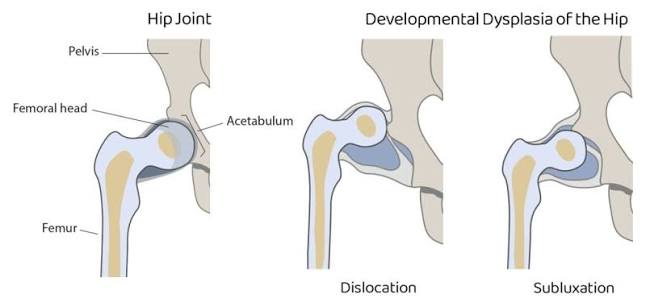
Developmental Dysplasia of the Hip (DDH) is a condition where a baby’s hip joint has not formed normally. To understand this, think of the hip as a ball-and-socket joint. The “ball” is the top of the thigh bone (femoral head), and the “socket” is a cup-shaped bone in the pelvis (acetabulum).
In a healthy hip, the ball fits snugly into the socket, allowing smooth movement. But in a baby with DDH, the socket may be too shallow, or the ligaments around the joint may be loose. This means the ball can slip out of the socket—partially or completely.
DDH is not a single condition but a spectrum of problems:
- Hip instability: The ball is loose in the socket but does not slip out.
- Subluxation: The ball is partially out of the socket.
- Dislocation: The ball is completely out of the socket.
DDH can affect one hip (unilateral) or both hips (bilateral).
The word “developmental” is important because the condition can develop before birth, during infancy, or even after birth as the child grows. This is why multiple hip checks during the first year of life are so important.
How Does DDH Affect a Baby’s Hip?
To help parents understand this better, imagine a golf ball sitting on a tee. If the tee (socket) is too shallow, the golf ball (femoral head) can easily roll off. That’s what happens in DDH—the ball doesn’t stay securely in the socket.
When the hip is not properly positioned, several things happen:
- The socket does not develop properly: The socket needs the pressure of the ball to grow into the correct shape.
- The ligaments stretch: Over time, the tissues around the joint become loose.
- The muscles become tight: The muscles around the hip may shorten and become stiff.
- The leg may become shorter: Over time, the affected leg may appear shorter than the other.
If DDH is not treated, the child may develop a limp, walk on their toes, or experience pain in the hip as they grow older. In adulthood, untreated DDH can lead to early arthritis and significant disability.
Causes of Developmental Dysplasia of the Hip
The exact cause of Developmental Dysplasia of the Hip is not fully understood. However, doctors believe it results from a combination of factors.
Ligament Laxity
Some babies are born with naturally loose ligaments. This can be influenced by maternal hormones particularly relaxin, which helps relax ligaments during pregnancy. Female babies are more susceptible to this hormone, which may explain why DDH is more common in girls.
Intrauterine Positioning
How a baby is positioned in the womb can affect hip development. In the final weeks of pregnancy, space becomes tight. If the baby is in the breech position (feet or bottom down), the hips may be in an abnormal position for a long time, affecting their development.
Genetic Factors
Some babies are born with a genetic tendency to develop DDH. If a parent or sibling had hip dysplasia, the baby is at higher risk.
Mechanical Factors
Any condition that restricts space in the womb such as low amniotic fluid (oligohydramnios) or a large baby can increase the risk of DDH.
Risk Factors
Developmental Dysplasia of the Hip is more likely to occur in babies with certain risk factors:
| Risk Factor | Why It Increases Risk |
|---|---|
| Female sex | Girls are more sensitive to maternal relaxin hormone, which causes ligament laxity. |
| Breech presentation | The hips are in an abnormal position for weeks, affecting development. |
| Family history | If a parent or sibling had DDH, the risk is higher. |
| First-born child | The womb is tighter in first pregnancies, restricting movement. |
| Low amniotic fluid | Less fluid means less space for the baby to move. |
| Large birth weight | A bigger baby has less room to move in the womb. |
| Other deformities | Conditions like torticollis (tight neck) or clubfoot are associated with DDH. |
| Incorrect swaddling | Swaddling with legs straight and tightly together can increase the risk. |
Important: Many babies with DDH have no risk factors at all. This is why every newborn should have their hips checked regularly.
Early Signs and Symptoms Parents Should Notice
Developmental Dysplasia of the Hip may not cause any obvious symptoms in the first few weeks. However, as a parent, you are in the best position to notice subtle changes. Here are the signs to watch for:
In Newborns and Young Infants:
- Uneven skin folds in the thighs or buttocks one side may have more folds than the other
- The leg on one side appears shorter than the other
- One leg turns outward more than the other
- Reduced movement on one side of the body
- A clicking or popping sound when moving the baby’s hip
In Older Infants and Toddlers:
- Limited hip abduction the leg does not open outwards as far as the other side
- A limp or waddling gait when walking
- Toe-walking on one side
- Leaning to one side when standing or walking
- Delayed walking—the child starts walking later than expected
Important Reminder:
Asymmetric skin creases alone are not a definite sign of DDH. Many healthy babies have uneven creases. However, if you notice this along with other signs, it is worth discussing with your paediatric orthopaedic surgeon.
How DDH is Diagnosed
Early diagnosis of Developmental Dysplasia of the Hip is the key to successful treatment. There are several ways doctors diagnose DDH.
1. Physical Examination
All newborns and infants should have their hips examined routinely. The doctor will perform two specific tests:
- Barlow Maneuver: The doctor gently adducts the hip (moves the knee across the body) and pushes the thigh backward. If the hip can be pushed out of the socket, the test is positive.
- Ortolani Maneuver: The doctor gently abducts the hip (moves the knee away from the body into a frog-leg position) and pulls it forward. A “clunk” sound or feeling means the hip is relocating into the socket.
These tests are most reliable in babies under 3 months of age. After that, the baby’s muscles become tighter, making the tests less sensitive.
2. Hip Ultrasound
Ultrasound is the preferred imaging test for babies under 4–6 months of age. It uses sound waves to create images of the hip joint and can show whether the ball is properly seated in the socket. Ultrasound is safe, painless, and does not use radiation.
Hip ultrasound is recommended for:
- Babies with abnormal physical examination findings
- Babies with significant risk factors (breech presentation, family history)
- Babies with asymmetric hip abduction after 4 weeks of age
3. X-Ray
For babies older than 4–6 months, X-rays are preferred because the bones have started to ossify (harden) and show up clearly on the image. X-rays use a small amount of radiation to show the position of the bones.
4. When Should Screening Happen?
- Clinical screening: At birth, 6–8 weeks, and again at 6–9 months during routine well-baby visits
- Ultrasound screening: For high-risk babies, an ultrasound is typically done at 4–6 weeks of age
- If a hip click or asymmetry is noted: An ultrasound should be done within 2 weeks
Normal Hip vs Developmental Dysplasia of the Hip
| Feature | Normal Hip | Developmental Dysplasia of the Hip |
|---|---|---|
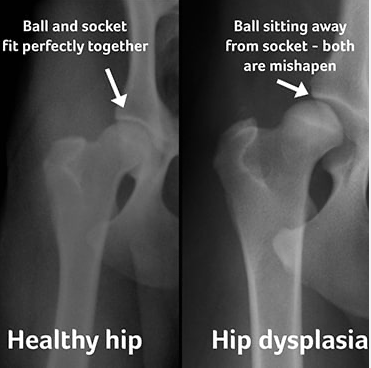
| Ball (femoral head) | Fits snugly in the socket | May be partially or completely out of the socket |
| Socket (acetabulum) | Well-formed and deep | Shallow or underdeveloped |
| Ligaments | Stable and supportive | Loose and stretchy |
| Movement | Full range of motion | Limited or asymmetrical movement |
| Skin folds | Symmetrical | May be uneven (though not always) |
| Walking | Normal gait | May have limp, waddle, or toe-walk |
| Long-term risk | Low | If untreated: early arthritis, pain, disability |
Treatment Options
The treatment for Developmental Dysplasia of the Hip depends on the child’s age and the severity of the condition.
Treatment Options by Child’s Age
| Age | Treatment | Success Rate |
|---|---|---|
| Birth to 6 months | Pavlik Harness (abduction brace) | 85–95% |
| 6–18 months | Closed reduction + hip spica cast | 64–98.9% depending on severity |
| 18 months to 6 years | Open reduction + surgery (pelvic/femoral osteotomy) | Variable |
| Over 6 years | Complex surgical reconstruction | Variable, more challenging |
1. Observation (For Mild Cases)
In some mild cases particularly in babies under 3 months with subtle findings the doctor may recommend observation with close follow-up. Many mild cases resolve spontaneously as the baby grows. However, if the hip does not improve, treatment will be started.
2. Pavlik Harness (Birth to 6 Months)
The Pavlik Harness is the first-line treatment for babies with DDH who are younger than 6 months. This is a soft, cloth harness that holds the baby’s legs in the “frog-leg” position hips bent and knees apart.
How it works: The harness keeps the ball of the thigh bone securely in the socket. As the baby grows, the socket develops around the ball, creating a stable joint.
What parents should know:
- The harness is worn full-time (23–24 hours a day) for about 6–12 weeks
- The baby can still be fed, bathed, and have nappy changes while wearing the harness
- Most babies adjust quickly and are comfortable in the harness
- Success rates are 85–95% when started early
From My Clinic: I always tell parents that the Pavlik Harness is not a punishment it is a gift. It allows the hip to heal naturally without surgery. The first few days may be challenging, but most babies adapt quickly, and parents soon become experts at managing the harness.
3. Hip Spica Cast (6–18 Months)
For babies diagnosed between 6 and 18 months of age, or for those who do not respond to the Pavlik Harness, a hip spica cast may be used. This is a rigid cast that holds the hip in the correct position.
The procedure:
- The child is placed under general anaesthesia
- The doctor gently moves the hip into the correct position (closed reduction)
- A cast is applied from the chest down to one or both legs, holding the hips in the frog-leg position
- The cast is typically worn for 6–12 weeks
Success rates with spica casting are excellent for mild to moderate cases (98.9% for types I and II) and 64% for more severe cases.
4. Closed Reduction (Without Surgery)
In some cases, a closed reduction (manipulating the hip into place without making an incision) is performed under anaesthesia, followed by a spica cast. This is typically done for children up to 18 months of age.
5. Surgery (When Required)
Surgery is needed when:
- The child is older than 18 months at diagnosis
- The Pavlik Harness or spica cast has failed
- The DDH is severe or has been detected late
Types of surgery include:
- Open reduction: The surgeon makes an incision and manually places the ball back into the socket
- Pelvic osteotomy: The surgeon reshapes the socket to better cover the ball
- Femoral osteotomy: The surgeon cuts and repositions the thigh bone to improve alignment
These surgeries are more complex and require a longer recovery period, but they can still achieve excellent results when performed by an experienced paediatric orthopaedic surgeon.
Importance of Early Diagnosis
The single most important factor in treating Developmental Dysplasia of the Hip is early diagnosis.
Why early diagnosis matters:
- Simpler treatment: Babies under 6 months usually need only a harness—no surgery, no hospital stay
- Higher success rates: Early treatment has a 85–95% success rate
- Better outcomes: The hip develops normally, and the child walks without a limp
- Lower risk of complications: Early treatment prevents the need for complex surgery later
- Reduced long-term problems: Prevents early arthritis and disability in adulthood
The challenge: DDH may not cause symptoms in the first few weeks. Some cases are silent” and cannot be found during a physical exam. This is why regular hip checks during well-baby visits are so important.
From My Clinic: I have seen too many children who were diagnosed late sometimes at 2 or 3 years of age when they started walking with a limp. These children often need surgery and a longer recovery. Early detection truly changes everything.
Recovery and Follow-up Care
After treatment for Developmental Dysplasia of the Hip, recovery and follow-up care are essential.
During Harness or Cast Treatment:
- Regular ultrasounds or X-rays: To check that the hip is staying in the correct position
- Skin checks: To prevent irritation from the harness or cast
- Developmental monitoring: To ensure the baby is meeting milestones
After Treatment:
- Continued monitoring: Children who have been treated for DDH need regular follow-up until their skeleton is fully mature (around adolescence).
- X-rays at regular intervals: To check that the hip is developing normally.
- Watch for complications: In rare cases, the hip may re-dislocate or the blood supply to the ball of the thigh bone may be affected (avascular necrosis).
When Can My Child Return to Normal Activities?
- After Pavlik Harness: Most babies resume normal activities immediately after the harness is weaned
- After spica cast: The child may need a short period of physiotherapy to regain strength and movement
- After surgery: Recovery takes longer typically 3–6 months before the child can walk normally
Can DDH Be Prevented?
Developmental Dysplasia of the Hip cannot always be prevented, but there are steps parents can take to reduce the risk.
During Pregnancy:
- Attend all prenatal appointments
- Discuss any risk factors (breech presentation, family history) with your doctor
After Birth:
- Avoid tight swaddling: When swaddling your baby, always leave room for the legs to bend and move freely. Tight swaddling with legs straight and together can increase the risk of DDH.
- Encourage “frog-leg” position: When your baby is lying on their back, allow their legs to fall into a natural bent position
- Babywearing: Using a baby carrier that supports the hips in a spread-squat position can promote healthy hip development
- Regular check-ups: Ensure your baby’s hips are checked at every well-baby visit
Tips for Parents to Support Healthy Hip Development
- Choose the right baby carrier: Look for carriers that support the “M-position” knees higher than the bottom, with the thighs supported.
- Avoid tight swaddling: When swaddling, the legs should be able to bend and move freely. The “hips healthy” swaddle allows the legs to fall into a natural frog-leg position.
- Encourage tummy time: This strengthens the baby’s muscles and allows the hips to move freely.
- Don’t rush walking: Let your child develop at their own pace. Pushing a child to walk early does not help hip development.
- Attend all well-baby visits: Hip checks should be a routine part of every check-up.
- Trust your instincts: If you notice something unusual about your baby’s legs or movement, speak to your doctor. You know your child best.
Common Myths About DDH
Myth 1: My baby will grow out of it.
Fact: Some mild cases do resolve spontaneously, but many do not. Waiting can make treatment more difficult and less successful.
Myth 2: DDH is caused by something I did during pregnancy.
Fact: DDH is not caused by anything a mother does or does not do. It is a developmental condition with multiple factors.
Myth 3: Only babies born breech get DDH.
Fact: While breech presentation is a major risk factor, most babies with DDH were not breech.
Myth 4: If there are no symptoms, there is no DDH.”
Fact: DDH can be “silent” in the early weeks. Regular screening is essential.
Myth 5: The Pavlik Harness will delay my baby’s development.
Fact: While the harness may temporarily limit some movements, babies continue to develop normally. Most babies catch up quickly after the harness is removed.
Myth 6: “DDH only affects girls.”
Fact: DDH is more common in girls, but it can affect boys too.
When Should You Consult a Pediatric orthopedic Surgeon?
You should consult a Pediatric orthopedic surgeon if :
- Your baby’s hips make a clicking, clunking, or popping sound during movement
- One leg appears shorter than the other
- There are uneven skin folds in the thighs or buttocks
- Your baby has limited or asymmetrical movement of one leg
- Your child has a limp, waddle, or toe-walk when they start walking
- Your child has a delay in walking compared to peers
- Your baby has risk factors for DDH (breech presentation, family history)
- You have any concern about your child’s hip development
Remember: Early consultation does not mean something is wrong it means you are being a proactive, caring parent.
Frequently Asked Questions (10 FAQs)
Q1. What is Developmental Dysplasia of the Hip (DDH)?
DDH is a condition where a baby’s hip joint has not formed normally. The “ball” of the thigh bone may be loose, partially out, or completely out of the socket.
Q2. How common is DDH in babies?
DDH affects about 1 to 1.5 per 1,000 births, though some studies estimate it affects 3 to 5 per 1,000 children when including milder cases.
Q3. Is DDH painful for my baby?
DDH is usually not painful in infants. Older children may experience discomfort or pain, especially if the condition is untreated.
Q4. Can DDH be treated without surgery?
Yes. For babies under 6 months, the Pavlik Harness is highly effective and avoids surgery entirely.
Q5. How long does my baby need to wear the Pavlik Harness?
Typically, the harness is worn full-time for 6–12 weeks, followed by a weaning period where it is worn part-time.
Q6. Will my baby need physiotherapy after treatment?
Some children benefit from physiotherapy after cast removal or surgery to restore strength and movement. This is usually short-term.
Q7. Can my baby still be breastfed while wearing the Pavlik Harness?
Yes. The harness does not interfere with feeding, bathing, or nappy changes.
Q8. What happens if DDH is not treated?
Untreated DDH can lead to a permanent limp, leg length discrepancy, pain, and early arthritis in adulthood.
Q9. Can DDH come back after treatment?
Recurrence is rare but possible. This is why regular follow-up is important until the child’s skeleton is fully mature.
Q10. When should I take my baby for a hip check?
Hips should be checked at birth, 6–8 weeks, and again at 6–9 months during routine well-baby visits. High-risk babies may need an ultrasound at 4–6 weeks.
Conclusion
Developmental Dysplasia of the Hip is one of the most common conditions I see as a Pediatric orthopedic surgeon. It is also one of the most treatable when caught early.
The journey from noticing something unusual to getting a diagnosis can be worrying for any parent. But I want you to know this: you are not alone, and your child can have a full, active life with the right care.
Early diagnosis means simpler treatment—often just a harness—and a lifetime of healthy movement. Late diagnosis may mean surgery and a longer recovery. The difference is early detection.
So, if you notice anything unusual about your baby’s legs or movement, do not wait. Do not listen to well-meaning relatives who say, “She will grow out of it.” Trust your instincts. Bring your child to a pediatric orthopeidcs specialist.
Dr. Dibya Ranjan Sahoo
Pediatric Orthopedics Doctor in Bhubaneswar
UTKAL ORTHO CARE, Pragati Enclave, MIG S 21, Niladri Vihar, Chandrasekharpur, Bhubaneswar, Odisha 751016
📞 +91 83288 83481
🌐 https://drdibyaranjansahoo.com
Disclaimer: This article is for educational purposes only. It does not substitute professional medical advice, diagnosis, or treatment. Always consult a qualified Paediatric Orthopaedics doctor for any medical concern regarding your child.
