
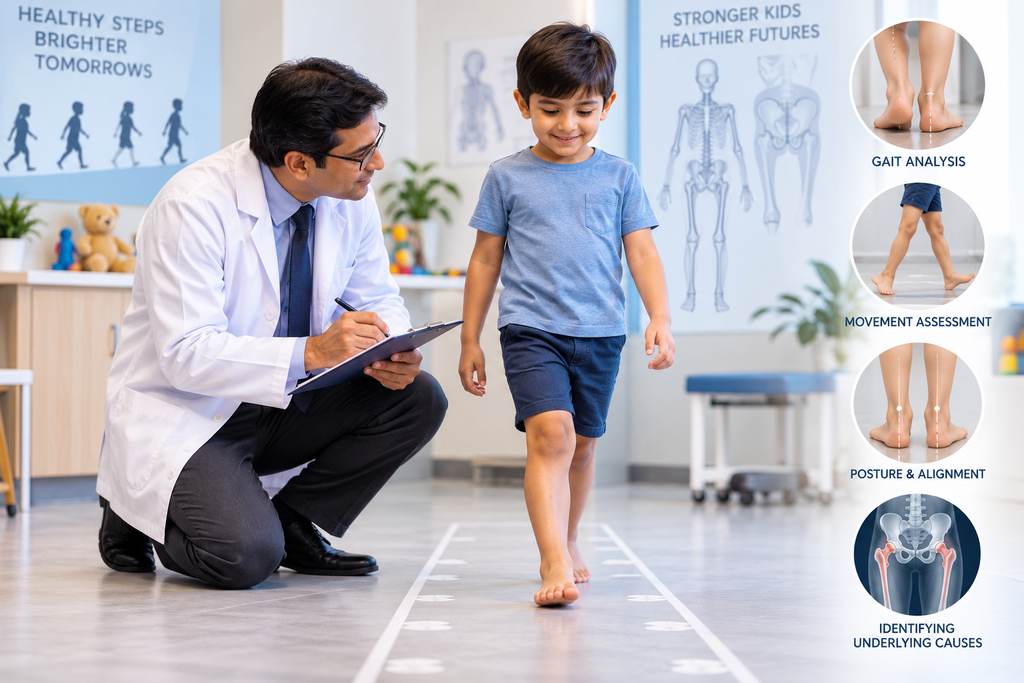
As a parent, you notice things. Perhaps your toddler walks on their toes more often than not. Maybe your five-year-old’s feet point inward when they run. You might have seen one leg move differently from the other, or noticed your child tripping far more frequently than their friends. These observations are not unusual and they are worth paying attention to.
Walking develops gradually during childhood. As bones lengthen, muscles strengthen, joints mature, and balance and coordination improve, a child’s walking pattern—their gait—naturally changes. What looks awkward at age two may be perfectly normal at age six. But when a walking pattern is persistent, one-sided, worsening, or accompanied by pain or weakness, it may signal what doctors call a pediatric gait abnormality, and an evaluation by a Pediatric Gait Specialist in bhubaneswar can help clarify whether treatment or monitoring is needed.
What Is a Pediatric Gait Abnormality?
Gait simply means the way a person walks. It includes step length, walking speed, foot placement, balance, and how the hips, knees, and arms move together.
A pediatric gait abnormality is a walking pattern that differs from what would generally be expected for a child’s age and stage of development. Importantly, not every unusual walking pattern is abnormal in a medical sense. Doctors become more concerned when a pattern is:
- Persistent beyond the age when it typically resolves
- Asymmetric, meaning one side moves very differently from the other
- Progressive, meaning it is getting worse over time
- Painful or associated with swelling, weakness, or other symptoms
It also helps to distinguish between:
- Normal developmental variation — common patterns that improve with growth, such as mild in-toeing in a toddler
- Temporary changes — limping after a minor stumble, for example
- Persistent gait abnormalities — patterns that remain or worsen despite growth
- Gait changes from injury or illness — sudden onset following trauma or infection
How Does a Child’s Walking Pattern Develop?
Children do not all walk the same way at the same age, and there is wide variation in what is considered normal. Still, general patterns emerge.
Most children begin walking independently between 11 and 16 months. Early walkers often use a wide stance, hold their arms up for balance, and take uneven steps. Heel-to-toe walking with reciprocal arm swing typically develops around 15 to 18 months, and running emerges after age two.
As children grow:
- Leg alignment changes — bowing in infancy gradually shifts to knock-knees around ages three to four, then straightens by age seven or eight
- Foot position changes — flat feet in toddlers often develop an arch by age six
- Balance and coordination improve — steps become narrower, smoother, and more consistent
- Motor control matures — adult-like gait and posture generally emerge around age eight
The key point for parents is this: there is no single “correct” age at which a child must walk a certain way. A doctor considers the whole picture age, development, symptoms, and function.
Common Types of Gait Abnormalities in Children
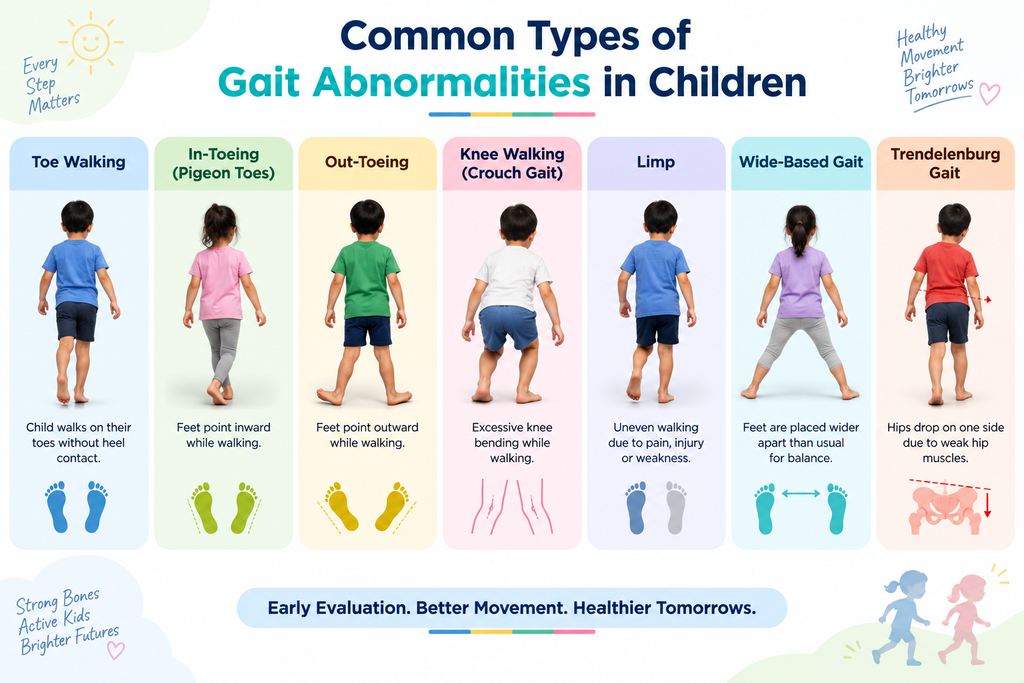
Toe Walking
Toe walking means a child walks on the balls of their feet without the heel touching the ground. It is common in toddlers learning to walk and often resolves by age three to five. Idiopathic toe walking toe walking without an underlying medical cause affects approximately 5% of healthy children.
When toe walking persists beyond age five, is one-sided, or is accompanied by tight heel cords, weakness, or developmental concerns, an evaluation is appropriate. Conditions such as cerebral palsy, muscular dystrophy, and some neuromuscular disorders can present with toe walking, though these are far less common than idiopathic toe walking.
In-Toeing
Parents often describe this as “pigeon-toed” walking. In-toeing can originate from the foot (metatarsus adductus), the lower leg (internal tibial torsion), or the thigh bone and hip (femoral anteversion).
Most cases of in-toeing are normal developmental variations that improve as the child grows. Internal tibial torsion is most common from the onset of walking to age three, while femoral anteversion is typically seen between ages three and eight. Over 90% of in-toeing cases resolve on their own, often by age eight to eleven. However, persistent, severe, or one-sided in-toeing may warrant assessment.
Out-Toeing
Out-toeing means the feet point outward while walking. In infants and toddlers, out-toeing is often a normal finding related to hip position in the womb. It tends to improve as walking develops. Out-toeing is less likely to resolve completely than in-toeing, and persistent cases—especially those causing pain or functional difficulty—should be evaluated.
Limping
A limp is an asymmetric gait, and it is always worth taking seriously. Trauma is the most common cause of limping in children, but other possibilities include joint inflammation, infection, bone or joint problems, and referred pain from the hip, knee, or abdomen. A sudden limp, a limp with fever, or a limp that persists beyond a few days requires prompt medical attention.
Uneven or Asymmetrical Walking
When one leg moves noticeably differently from the other, parents may notice uneven steps, one foot dragging, or the body leaning to one side. This pattern is more concerning than symmetric gait variations because it may indicate a problem affecting one limb specifically—such as a leg-length difference, a focal joint issue, or a neurological condition.
Frequent Tripping or Falling
Occasional falls are normal in young children, especially when they are learning to run, climb, or navigate uneven surfaces. However, frequent falls that persist beyond the toddler years, worsen over time, or occur alongside other symptoms such as weakness or clumsiness may benefit from evaluation.
Stiff or Awkward Gait
Some children walk with stiff knees, a rigid posture, or movements that look awkward or effortful. This can have multiple causes, including muscle tightness, joint stiffness, neurological conditions, or simply a developmental phase. A clinical examination helps distinguish between these possibilities.
What Causes Abnormal Walking in Children?
Causes of abnormal gait in children vary widely, from completely benign to those requiring medical treatment. They include:
- Normal developmental variations — in-toeing, out-toeing, flat feet
- Foot and ankle alignment issues — metatarsus adductus, clubfoot
- Rotational alignment differences — tibial torsion, femoral anteversion
- Leg-length differences — congenital or acquired
- Muscle weakness or tightness — including conditions affecting muscle tone
- Joint problems — inflammation, infection, or mechanical issues
- Bone deformities — such as Blount’s disease
- Previous injuries — fractures or soft tissue injuries that have not healed optimally
- Neuromuscular conditions — cerebral palsy, muscular dystrophy, peripheral neuropathies
- Developmental conditions — autism spectrum disorder, developmental coordination disorder
- Pain-related gait changes — limping or altered walking to avoid discomfort
- Other medical conditions — including infections, inflammatory diseases, and rare metabolic disorders
This list is not exhaustive, and it is important not to assume the worst. Most gait variations in children are not caused by serious disease. A thorough clinical evaluation is the only reliable way to determine the cause.
When Is an Unusual Walking Pattern Normal?
Many walking patterns that concern parents are actually normal for the child’s age. Doctors consider several factors when deciding whether a pattern is within the range of normal:
- The child’s age — what is normal at two is different from what is normal at ten
- Duration — has the pattern been present for weeks, months, or years?
- Trend — is it improving, stable, or worsening?
- Symmetry — are both sides affected similarly?
- Pain — is the child uncomfortable or reluctant to walk?
- Function — can the child keep up with peers, run, climb stairs, and participate in play?
- Overall development — are other developmental milestones on track?
Warning Signs Parents Should Not Ignore
While many gait variations are harmless, certain signs should prompt a timely medical evaluation:
- Persistent limping, especially lasting more than a few days
- Sudden change in walking pattern
- Significant pain while walking or refusal to walk
- Repeated falls beyond the typical toddler years
- Progressive worsening of gait over time
- Clearly one-sided or asymmetric walking
- Weakness in the legs
- Loss of previously acquired walking abilities
- Persistent toe walking beyond age five
- Difficulty running, climbing stairs, or keeping up with peers
- Swelling, redness, or obvious deformity
- Walking problems following an injury
- Walking difficulty accompanied by fever, rash, or general unwellness
These signs do not automatically mean a serious condition is present. They simply indicate that a professional assessment is appropriate.
How Does a Pediatric Orthopedic Surgeon Evaluate a Child’s Walking?
A pediatric orthopedic evaluation is thorough, systematic, and tailored to the child’s age and stage of development.
Medical History
The doctor will ask about:
- When the child started walking
- When the unusual pattern was first noticed
- Whether the pattern is improving, stable, or worsening
- Whether there is pain, and if so, when it occurs
- Any previous injuries or falls
- Developmental milestones
- Family history of similar walking patterns
- Physical activity level and participation in sports
- Any other medical conditions or concerns
Observing the Child Walk
Observation is a central part of gait assessment. The doctor may watch the child walk, run, and climb stairs, paying attention to:
- Walking speed and step length
- Foot placement and heel-to-toe movement
- Symmetry between left and right sides
- Hip and knee motion
- Arm swing
- Balance and stability
- Running pattern and ability to change direction
In some cases, a short video recorded by parents at home can provide useful additional information about how the child walks in their natural environment.
Does Every Child with an Abnormal Gait Need an X-Ray or MRI?
No. Imaging is not automatically required for every child with a gait variation.
The decision to order imaging whether an X-ray, ultrasound, blood test, MRI, or other investigation depends on:
- The child’s age
- The history and physical examination findings
- The duration and severity of the gait pattern
- The presence of pain, swelling, or other symptoms
- Whether the pattern is improving or worsening
Many gait variations, such as mild in-toeing or flexible flat feet, can be diagnosed through history and examination alone and do not require imaging. When imaging is needed, it is chosen selectively to answer specific clinical questions.
What Happens After the Evaluation?
Management depends entirely on the underlying cause. Possible approaches include:
- Observation and reassurance — when the pattern is a normal developmental variation
- Activity modification — reducing or changing activities that aggravate symptoms
- Physiotherapy — targeted stretching or strengthening when appropriate
- Orthotic management — shoe inserts or braces in selected cases
- Treatment of an underlying condition — such as infection or inflammation
- Further investigations — if the initial evaluation suggests a need
- Surgical treatment — only when clinically indicated and after careful discussion
Every child is different, and treatment plans should be individualized. A gait pattern that requires monitoring in one child may need active treatment in another, depending on the cause and functional impact.
Why Early Evaluation Can Matter
For many children, a gait variation is simply a phase that resolves with growth. For others, timely evaluation can identify a condition that benefits from treatment, monitoring, or referral to another specialist. Early evaluation does not mean early treatment sometimes the most appropriate recommendation is reassurance and observation. But when a problem does exist, identifying it sooner rather than later often allows for simpler, more effective management.
What Parents Can Do Before a Pediatric Orthopedic Consultation
Preparing for a consultation helps the doctor understand your child’s situation more clearly. Consider:
- Observing when the pattern occurs — is it constant, or only when tired, running, or barefoot?
- Noting which legs are affected — one side or both?
- Recording when the pattern started — days, weeks, months, or years ago?
- Watching for pain — does your child complain of discomfort or avoid certain activities?
- Tracking falls — are they frequent, and do they seem different from typical toddler falls?
- Monitoring the trend — is the walking getting better, staying the same, or getting worse?
- Taking a short video — a 30-second clip of your child walking and running can be very helpful, though it does not replace in-person examination
- Bringing previous medical records — including any imaging, reports, or notes from other doctors
Frequently Asked Questions About Child Gait
What is a pediatric gait abnormality?
It is a walking pattern that differs from what is expected for a child’s age and development, particularly when it is persistent, asymmetric, progressive, or associated with other symptoms.
Is toe walking normal in children?
Toe walking is common in toddlers and often resolves by age three to five. Persistent toe walking beyond age five, or toe walking with other symptoms, should be evaluated.
When should I worry about my child’s walking pattern?
Worry is not the right framework. Instead, consider whether the pattern is persistent, painful, one-sided, worsening, or affecting your child’s ability to keep up with peers. If so, an evaluation is reasonable.
Why does my child walk with one foot turned inward?
In-toeing can come from the foot, lower leg, or hip. Most cases improve with growth, but persistent or severe cases may benefit from assessment.
Why does my child limp while walking?
Limping has many possible causes, from minor injury to joint or bone problems. A limp that is sudden, painful, or lasts more than a few days should be evaluated.
Do children outgrow in-toeing?
Most do. Over 90% of in-toeing resolves by age eight to eleven, though some children continue to have mild in-toeing without functional problems.
Does abnormal walking always require treatment?
No. Many gait variations require only observation and reassurance. Treatment is recommended when there is a specific condition that would benefit from intervention.
Does every child with a gait abnormality need an X-ray?
No. Imaging is used selectively based on history, examination findings, and clinical judgment.
When should I see a pediatric orthopedic surgeon?
Consider consultation when a walking pattern is persistent, painful, asymmetric, worsening, or affecting your child’s daily activities.
Can physiotherapy help children with walking problems?
Physiotherapy can be helpful for certain conditions involving muscle tightness, weakness, or coordination. Whether it is appropriate depends on the underlying cause.
When Should You Consult a Pediatric Orthopedic Surgeon?
Parents may consider a consultation when a child’s walking pattern is:
- Persistent beyond the age when it typically resolves
- Painful or associated with swelling
- Clearly asymmetric, with one leg moving differently from the other
- Getting worse over time
- Affecting daily activities such as walking to school, playing, or participating in sports
- Associated with frequent falls
- Associated with weakness or loss of previously acquired skills
- Associated with obvious deformity
- Associated with difficulty running or keeping up with peers
Parents in Cuttack who are concerned about a child’s walking pattern can consult a qualified pediatric orthopedic surgeon for a clinical assessment. Dr. Dibya Ranjan Sahoo, a pediatric orthopedic surgeon practicing in Cuttack, Odisha, evaluates children with a range of gait-related concerns, from common developmental variations to more complex orthopedic and neuromuscular conditions. A consultation provides an opportunity to discuss your observations, have your child examined, and receive guidance on whether monitoring, treatment, or referral is appropriate.
Conclusion
Children’s walking patterns change as they grow. Many variations—mild in-toeing, out-toeing, flat feet, or toe walking in early childhood—are normal parts of development that improve with time.
Evaluation by a pediatric orthopedic specialist involves a detailed history, observation of the child walking, and a thorough physical examination. Imaging and other tests are used selectively. Treatment depends on the underlying cause and may range from simple observation to physiotherapy, orthotics, or other interventions when clinically indicated. If you are looking for a Pediatric Gait Specialist in bhubaneswar a timely consultation can provide clarity and peace of mind.
Worried About Your Child’s Walking? Here’s How a Pediatric Orthopedic Evaluation Can Help.
If your child’s walking worries you persistent limping, toe walking, in-toeing, frequent falls, or one-sided patterns a pediatric orthopedic evaluation can bring clarity. The doctor reviews history, watches your child walk and run, and performs a thorough physical exam. Imaging is used only when needed. This process helps distinguish normal developmental variations from conditions that may benefit from monitoring or treatment. You leave with answers and a plan. For concerns in Cuttack, consult a Pediatric Gait Specialist in bhubaneswar.
Meet Your Doctor : Dr Dibya Ranjan Sahoo

Looking for expert pediatric gait care in Bhubaneswar? Dr. Dibya Ranjan Sahoo is a distinguished Pediatric Orthopedic Surgeon with comprehensive training and experience in evaluating and treating musculoskeletal conditions that affect how children walk. Dedicated to accurate diagnosis and evidence-based treatment, he designs personalized plans for toe walking, in-toeing, out-toeing, limping, and other pediatric gait abnormalities. His professional guidance can help your child walk more comfortably, improve mobility, and participate fully in play and daily activities.
Visit Dr Dibya Ranjan Sahoo Clinic at bhubaneswar
Address :- Pragati Enclave, MIG S 21, Niladri Vihar, Chandrasekharpur, Bhubaneswar, Odisha 751016
Visit Location :- https://maps.app.goo.gl/j6koGD25RD3YLhvB8
Book an appointment today and get a consultation
