

What Is Frozen Shoulder?
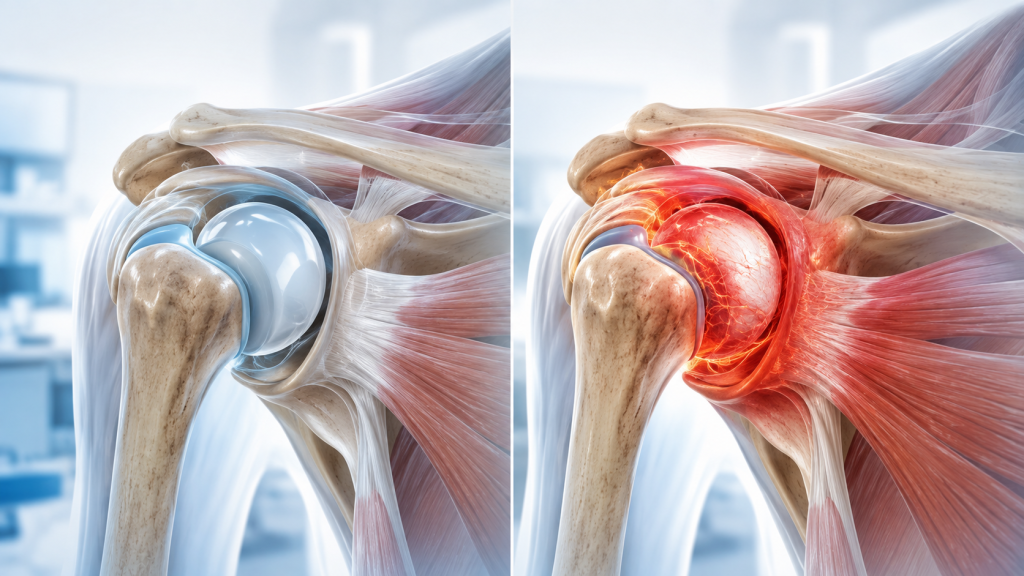
Frozen shoulder, medically known as adhesive capsulitis, is a condition characterized by pain, stiffness, and limited range of motion in the shoulder joint. It occurs when the capsule of connective tissue surrounding the shoulder joint becomes inflamed, thickened, and tight. This leads to the formation of bands of scar-like tissue called adhesions, which restrict movement. The amount of lubricating fluid in the joint may also decrease, making movement even harder.
Think of your shoulder joint like a ball inside a socket, wrapped in a flexible bag (the capsule). Normally, this bag allows smooth, pain-free movement in multiple directions. But with frozen shoulder, the bag shrinks and tightens, gripping the ball so tightly that movement becomes painful and limited.
Frozen shoulder most commonly affects people between the ages of 40 and 60, and it is more frequent in women. It typically involves only one shoulder, though some people may develop it in both shoulders over time. The condition can interfere with daily activities such as dressing, bathing, and reaching overhead And if you’re looking for the best orthopedic doctor in Bhubaneswar, we’ll help you understand when and why to seek professional care..
What Causes Frozen Shoulder?
The exact cause of frozen shoulder is not fully understood. In many cases, it appears without any clear reason—this is called primary or idiopathic frozen shoulder. However, researchers believe that inflammation and fibrosis (thickening and stiffening) of the shoulder capsule play a key role.
Frozen shoulder can be classified into two main types:
Primary Adhesive Capsulitis: This form occurs without an obvious triggering event. It’s thought to arise from intrinsic inflammation leading to fibrotic changes within the shoulder capsule. It is frequently associated with systemic conditions such as diabetes and thyroid disorders, suggesting an underlying inflammatory or autoimmune component.
Secondary Adhesive Capsulitis: This form results from an external event, such as trauma, surgery, or a period when the shoulder has been immobilized. It can also develop after a shoulder injury, rotator cuff problems, or fractures.
In simple terms, frozen shoulder happens when you don’t move your shoulder enough, allowing the capsule to tighten and stick together. This is why it’s common after surgeries, injuries, or any situation where you keep your arm still for a long time.
Risk Factors
Several factors can increase your likelihood of developing frozen shoulder:
Age and Gender
People aged 40 and older, particularly women, are more likely to develop frozen shoulder. The condition most commonly affects individuals between 40 and 70 years old.
Diabetes
Diabetes is one of the strongest risk factors for frozen shoulder. People with diabetes have a 2 to 4 times increased risk. Insulin-dependent diabetics have a 36% chance of developing the condition, and it tends to be more severe in diabetics.
Thyroid Disorders
Both overactive (hyperthyroidism) and underactive (hypothyroidism) thyroid conditions are linked to a higher risk of frozen shoulder.
Immobility
Prolonged shoulder immobility is a major risk factor. This can happen after:
Other Medical Conditions
- Cardiovascular disease
- Parkinson’s disease
- Cervical disk disease
- Hormonal changes, such as during menopause
Stages of Frozen Shoulder
Frozen shoulder typically develops slowly and progresses through three distinct stages:
Stage 1: Freezing Stage
This is the painful phase. Any movement of the shoulder causes pain, and the shoulder’s range of motion becomes increasingly limited. This stage typically lasts 2 to 9 months. During this time, the pain may be severe and can disrupt sleep.
Stage 2: Frozen Stage
Pain may lessen during this stage, but the shoulder becomes stiffer. Using the shoulder becomes more difficult. This stage lasts approximately 4 to 12 months. Many people find that while the pain improves, the stiffness makes everyday tasks challenging.
Stage 3: Thawing Stage
During this recovery phase, the shoulder’s ability to move begins to improve. This stage typically lasts 5 to 24 months. Full recovery may take up to two years or longer.
It’s important to note that these stages can overlap, and the duration may vary significantly from person to person.
Common Symptoms
The main symptoms of frozen shoulder are pain and stiffness. Here’s what you might experience:
- Dull or aching pain in the shoulder
- Stiffness that makes it difficult to move the shoulder
- Reduced range of motion you can’t reach as far as you used to
- Night pain that can disturb your sleep
- Difficulty with daily activities like dressing, reaching overhead, or bathing
- Pain that worsens with forceful movements
The pain may start gradually without any obvious cause or after minor trauma. Over time, the lack of movement leads to stiffness and even less motion. Eventually, you may not be able to do movements such as reaching over your head or behind your back.
How Frozen Shoulder Is Diagnosed
Diagnosing frozen shoulder is usually straightforward and primarily based on a clinical examination. Here’s what to expect:
Physical Examination
Your doctor will ask about your symptoms and examine your shoulder. They will check both active motion (how far you can move your shoulder on your own) and passive motion (how far the shoulder can be moved by someone else). A key sign of frozen shoulder is the inability to rotate the shoulder outward.
Imaging Tests
While imaging isn’t always necessary, your doctor may recommend:
- X-rays to rule out other problems such as arthritis or calcium deposits
- MRI to look for inflammation, though this is usually not needed for diagnosis
The American Academy of Orthopedic Surgeons defines frozen shoulder as “a condition of varying severity characterized by the gradual development of global limitation of active and passive shoulder motion where radiographic findings other than osteopenia are absent”.
Treatment Options
Treatment for frozen shoulder focuses on pain control, restoring movement, and improving function. The good news is that most people improve with non-surgical treatments.
Medicines
Pain relief is often the first step. Treatment typically starts with:
- Paracetamol for mild pain
- Non-steroidal anti-inflammatory drugs (NSAIDs) like ibuprofen
- Stronger painkillers may be prescribed for short-term relief
Physiotherapy
Physiotherapy is one of the most effective treatments for frozen shoulder. A physiotherapist will design a program tailored to your needs, which usually includes:
- Stretching exercises to improve range of motion
- Strengthening exercises
- Posture advice
- Pain relief techniques
Physiotherapy typically lasts at least 6 weeks. Regular stretching improves range of motion, prevents further stiffness, and supports functional recovery.
Exercises
Home exercises are a crucial part of recovery. Gentle, consistent stretching helps restore movement and prevent further stiffness. We’ll cover specific exercises in the next section.
Steroid Injections
Corticosteroid injections into the shoulder joint can help reduce pain and improve movement. They are most effective when given soon after frozen shoulder begins. Steroid injections provide short-term pain relief and work best when combined with structured exercise.
Hydrodilatation
Hydrodilatation is a procedure where sterile fluid is gently injected into the shoulder joint to expand and stretch the joint capsule. This can help break up adhesions and restore movement. Studies show that hydrodilatation with steroid injections can be beneficial.
Surgery (When Required)
Surgery is rarely needed and is usually reserved for cases that don’t respond to non-surgical treatment. Surgical options include:
- Manipulation under anesthesia: The shoulder is moved through a full range of motion while you’re asleep to break up adhesions
- Arthroscopic capsular release: Tight ligaments and scar tissue are cut using small incisions and a camera
After surgery, physical therapy is essential to maintain the regained motion and prevent recurrence.
Best Exercises for Frozen Shoulder
Exercises are the cornerstone of frozen shoulder recovery. Remember to start gently and never push through severe pain. Here are some safe and effective exercises:
1. Pendulum Stretch
- Lean forward slightly, letting your affected arm hang down
- Gently swing your arm in small circles
- Do 10 circles in each direction, twice daily
2. Cross-Body Reach
- Use your good arm to lift your affected arm at the elbow
- Gently pull it across your body toward the opposite shoulder
- Hold for 15-30 seconds
- Repeat 3-5 times, twice daily
3. Towel Stretch
- Hold a towel behind your back with both hands
- Use your good arm to gently pull the towel upward, stretching your affected arm
- Hold for 15-30 seconds
- Repeat 3-5 times
4. Finger Walk
- Stand facing a wall at arm’s length
- Use your fingers to “walk” up the wall as high as comfortable
- Slowly walk back down
- Repeat 5-10 times
5. Armpit Stretch
- Use your good arm to lift your affected arm onto a shelf or table at chest height
- Gently bend your knees, deepening the stretch in your armpit
- Hold for 15-30 seconds
- Repeat 3-5 times
Important: Always consult a physiotherapist before starting any exercise program. They can ensure you’re doing the exercises correctly and safely.
Recovery Time
Recovery from frozen shoulder takes time and patience. Here’s what you can expect:
- With treatment, it may take a few weeks to see progress
- Complete recovery may take 9 months to a year
- Even without treatment, frozen shoulder often gets better on its own within 2 years
Several factors affect recovery time:
- How early you start treatment
- The severity of your condition
- Your overall health, especially if you have diabetes or other underlying conditions
- How consistently you do your exercises
While frozen shoulder is usually self-limiting (it resolves on its own over time), treatment can significantly speed up recovery and reduce discomfort.
Can Frozen Shoulder Be Prevented?
While not all cases of frozen shoulder can be prevented, there are steps you can take to reduce your risk:
Keep Moving
One of the most common causes of frozen shoulder is not moving the shoulder while recovering from an injury, broken arm, or stroke. If you’ve had an injury that makes it difficult to move your shoulder, talk to your healthcare provider about exercises that can help you maintain mobility.
Manage Underlying Conditions
- If you have diabetes, keep your blood sugar under control
- If you have thyroid problems, follow your treatment plan
- Early treatment of shoulder pain may help prevent stiffness
Early Intervention
If you develop shoulder pain that limits your range of motion for an extended period, seek medical advice promptly. The earlier you address the problem, the better your chances of a quick recovery.
When Should You Visit a Doctor?
- You have shoulder pain and stiffness that does not go away
- The pain is so bad it makes it hard to move your arm and shoulder
- You’ve had a shoulder injury or surgery and notice increasing stiffness
- Your shoulder pain is disrupting your sleep
Red Flags to Watch For
- Severe pain that doesn’t improve with rest
- Sudden inability to move your shoulder
- Swelling or redness around the joint
- Fever or other signs of infection
Don’t wait for the condition to get worse. Early diagnosis and treatment can make a significant difference in your recovery. If you’re in Bhubaneswar, consulting the best orthopedic doctor in Bhubaneswar can help you get an accurate diagnosis and a personalized treatment plan.
Frequently Asked Questions
1. What is the fastest way to cure frozen shoulder?
There’s no instant cure, but the fastest way to recover is through early treatment combining physiotherapy, prescribed exercises, and sometimes steroid injections. Consistency with your exercise program is key to speeding up recovery.
2. Can frozen shoulder go away on its own?
Yes, frozen shoulder often resolves on its own within 1 to 3 years. However, treatment can significantly speed up recovery, reduce pain, and prevent long-term stiffness.
3. What is the best treatment for frozen shoulder?
The best treatment varies by individual but typically includes physiotherapy, home exercises, and pain management. Steroid injections or hydrodilatation may be recommended for more severe cases. A consultation with the best orthopedic doctor in Bhubaneswar can help determine the right approach for you.
4. How long does frozen shoulder last?
Frozen shoulder typically lasts 1 to 3 years. The freezing stage lasts 2-9 months, the frozen stage 4-12 months, and the thawing stage 5-24 months.
5. What exercises should I avoid with frozen shoulder?
Avoid heavy lifting, sudden jerky movements, or pushing through severe pain. Always start gently and consult a physiotherapist before beginning any exercise program.
6. Is frozen shoulder more common in diabetics?
Yes, significantly so. People with diabetes have a 2 to 4 times higher risk of developing frozen shoulder. Insulin-dependent diabetics have a 36% chance of developing it.
7. Can frozen shoulder affect both shoulders?
Yes, while it usually affects only one shoulder, some people can develop it in the other shoulder, typically within five years.
8. Does frozen shoulder require surgery?
Surgery is rarely needed and is usually reserved for cases that don’t respond to non-surgical treatments. Most people improve with physiotherapy, exercises, and medications.
9. What is the difference between frozen shoulder and rotator cuff injury?
Frozen shoulder involves the joint capsule tightening, causing global stiffness in all directions. A rotator cuff injury involves damage to the tendons that surround the shoulder, typically causing pain with specific movements.
10. Can I prevent frozen shoulder after surgery?
Yes, early movement and gentle exercises after surgery can help prevent frozen shoulder. Always follow your surgeon’s and physiotherapist’s guidance on when and how to start moving your shoulder.
Conclusion
Don’t let shoulder pain hold you back any longer.
If you’re struggling with shoulder stiffness, pain, or limited movement, professional help is just a call away. Dr. Dibyaranjan Sahoo a leading orthopedic and robotic joint replacement specialist provides comprehensive care for frozen shoulder and other shoulder conditions. From accurate diagnosis to personalized treatment plans including physiotherapy and advanced procedures, expert care is available right here in Bhubaneswar.
Visit us at: Pragati Enclave, MIG S 21, Neeladri Vihar, Chandrasekharpur, Bhubaneswar, Odisha 751016
Call to book an appointment
Learn more: drdibyaranjansahoo.com
Take the first step toward pain-free movement today. Schedule a consultation with the best orthopedic doctor in Bhubaneswar and get back to living the life you deserve.
