
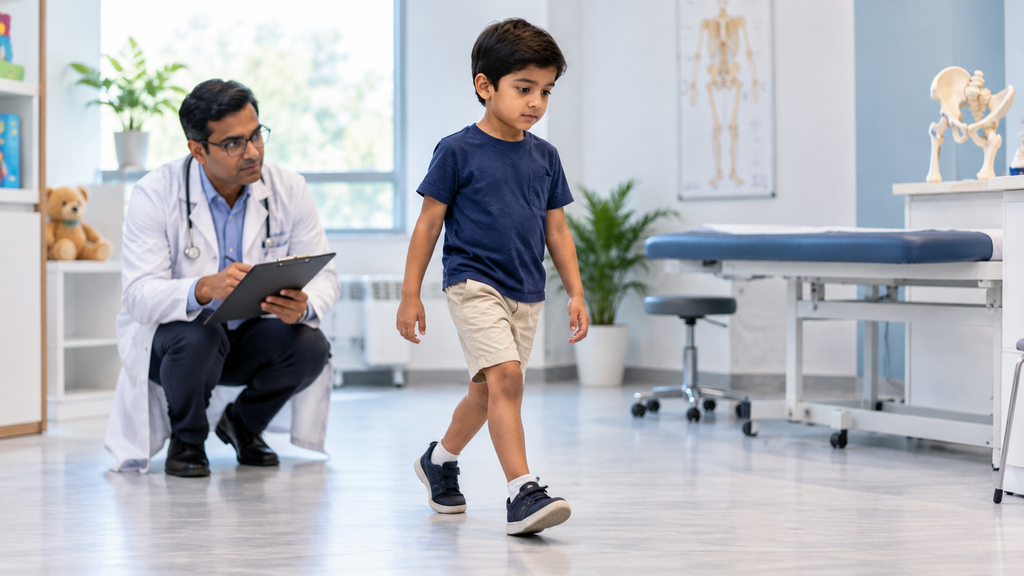
Watching your child take their first steps is a cherished milestone. As they grow, their walking pattern naturally evolves—from the wide, unsteady gait of a toddler to the confident stride of a school-going child. But what happens when you notice something different? Perhaps your child limps, walks on their toes, turns their feet inward, or seems to avoid using one leg. As a parent, it’s natural to worry.
While some variations in walking are part of normal development, persistent or noticeable changes such as limping, toe walking, frequent tripping, or difficulty keeping up with peers may deserve professional evaluation. The important thing to remember is that you should not attempt to diagnose the cause yourself. A qualified Pediatric Orthopedic Doctor in Bhubaneswar can assess your child’s gait, identify any underlying concerns, and guide you toward appropriate care if needed.
When parents say their child is “walking differently,” they may be describing a range of observations. These can include:
- Limping: An uneven walk where one leg is favored or avoided
- Toe walking: Walking on the balls of the feet without the heels touching the ground
- In-toeing: Feet pointing inward (sometimes called “pigeon-toed”)
- Out-toeing: Feet pointing outward
- Frequent tripping or falling: More than expected for the child’s age
- Uneven steps: One leg taking shorter or longer strides
- Walking with one leg differently: Asymmetry in movement
- Avoiding certain activities: Reluctance to run, jump, or climb
- Difficulty running or climbing: Struggling with activities peers find easy
- Changes in walking after an injury: A noticeable difference following a fall or trauma
Some of these gait variations are temporary or developmentally normal. Others may indicate an underlying issue that needs assessment.
When Is an Unusual Walking Pattern Normal?
Not every unusual walking pattern indicates a medical problem. Children’s walking patterns can vary widely based on:
- Age and developmental stage: A toddler’s gait differs significantly from that of a seven-year-old.
- Muscle strength and coordination: These develop gradually over time.
- Previous injuries: A recent minor injury may temporarily affect walking.
- Foot structure: Some children naturally have flat feet or high arches.
- Normal developmental variation: Many gait patterns correct themselves as children grow.
However, persistent, worsening, painful, or functionally limiting changes should be discussed with a healthcare professional. Trust your instincts if something feels off, it’s worth getting checked.
Could the Problem Come From the Feet?
Foot-related issues can significantly influence how a child walks. Common concerns include:
- Flat feet: While often normal in young children, rigid or painful flat feet may need evaluation.
- In-toeing or out-toeing: These can be related to lower-limb alignment and may resolve on their own or require assessment.
- Foot pain: Discomfort in the foot or ankle can cause limping or avoidance of weight-bearing.
- Uneven foot posture: One foot may appear different from the other.
- Structural foot conditions: Certain congenital or acquired conditions can affect gait.
- Foot or ankle injuries: Sprains, fractures, or strains can alter walking.
- Balance or stability problems: These can lead to frequent tripping or falling.
It’s important not to assume that the appearance of the feet alone determines whether treatment is needed. A professional evaluation considers the entire lower limb.
Could the Problem Come From the Hips?
Hip conditions can also affect gait and movement. Symptoms parents may notice include:
- Limping: Often the first sign of a hip problem
- Hip or groin discomfort: Your child may complain of pain in this area
- Pain referred to the thigh or knee: Hip problems can cause pain in seemingly unrelated areas
- Reduced hip movement: Stiffness or difficulty moving the leg
- Difficulty running or climbing: Activities that require hip flexibility may be challenging
- Avoiding certain movements: Your child may resist specific activities
- Asymmetry between the legs: One leg may appear shorter or rotate differently
One condition that can affect hip development is Developmental Dysplasia of the Hip (DDH) , where the hip joint does not form properly. Only a qualified healthcare professional can evaluate and diagnose DDH or other hip conditions.
Why Do Children Limp?
Limping can have many possible causes. These range from minor injuries and temporary problems to orthopedic, inflammatory, infectious, or developmental conditions. Some common causes include:
- Minor trauma: A fall or twist that causes temporary discomfort
- Overuse injuries: From sports or repetitive activities
- Infections: Such as transient synovitis (irritation of the hip joint)
- Inflammatory conditions: Such as juvenile arthritis
- Orthopedic conditions: Including fractures, DDH, or Legg-Calvé-Perthes disease
- Neurological or muscular conditions: Affecting movement and coordination
Do not attempt to diagnose your child based on a single symptom. Persistent or unexplained limping deserves medical assessment to rule out serious conditions and ensure appropriate care.
Signs Parents Should Not Ignore
While some walking variations can be monitored, certain signs require prompt medical attention:
Monitor and Discuss with Your Doctor:
- Occasional toe walking in a toddler
- Mild in-toeing that is not worsening
- Flat feet without pain or functional limitation
Seek Medical Evaluation:
- Persistent or recurring limping
- Pain in the hip, leg, knee, foot, or ankle
- Sudden changes in walking
- One leg appearing or moving differently
- Significant stiffness or reduced movement
- Frequent unexplained falls or tripping
- Persistent toe walking beyond age 3-4
- Walking problems that are getting worse
Seek Prompt Medical Attention:
- Refusal to walk or bear weight
- Symptoms following a significant injury
- Fever along with joint or limb symptoms
- Severe or rapidly worsening pain
- Sudden severe swelling
- Child appearing seriously unwell
Foot Problem vs Hip Problem: How Can Parents Tell?
| What Parents Notice | Possible Area Involved | What to Do |
| Pain in the foot or ankle | Foot/ankle | Consider medical evaluation if persistent |
| Foot turning inward/outward | Foot/lower limb alignment | Discuss with pediatrician or orthopedic specialist if persistent |
| Limping with hip/groin discomfort | Hip | Seek professional assessment |
| Reduced hip movement | Hip | Arrange medical evaluation |
| Frequent tripping | Foot, leg, balance, or gait | Consider evaluation if persistent |
| Refusal to bear weight | Foot, leg, or hip | Seek prompt medical assessment |
These observations are not diagnoses, and symptoms can overlap. A professional evaluation is the best way to determine the underlying cause.
When Should Parents See a Pediatric Orthopedic Doctor?
Professional evaluation is appropriate when your child has:
- Persistent abnormal walking
- Pain that continues or returns
- Repeated limping
- Difficulty participating in normal activities
- Significant gait changes
- Concerns about hip or foot development
- Symptoms after injury
- Refusal to walk or bear weight
- Sudden or worsening symptoms
If you are in Bhubaneswar or nearby areas like Cuttack, Khordha, Puri, Jajpur, or Dhenkanal, consulting a Pediatric Orthopedic Specialist in Bhubaneswar can provide clarity and peace of mind.
What Happens During a Pediatric Orthopedic Assessment?
A pediatric orthopedic evaluation is designed to be thorough yet child-friendly. It may include:
- Medical and developmental history: Discussion of your child’s growth, milestones, and any relevant family history
- Discussion of symptoms: When the walking change started, what you’ve noticed, and whether symptoms are constant or intermittent
- Observation of walking and running: The doctor will watch your child move
- Examination of the feet, ankles, knees, hips, and legs: Checking for alignment, tenderness, and range of motion
- Assessment of range of motion: Evaluating flexibility and movement
- Evaluation of alignment and muscle function: Checking for asymmetry or weakness
- Comparison of both sides: Identifying differences between the left and right sides
- Imaging such as X-rays or ultrasound when clinically appropriate
- Additional tests when necessary
The exact evaluation depends on your child’s age, symptoms, and clinical findings.
Do All Children with Walking Problems Need Treatment?
Treatment depends on the underlying cause. Some children may simply need observation and periodic assessment as they grow. Others may require:
- Physiotherapy: To improve strength, flexibility, and coordination
- Activity modification: To allow healing or prevent worsening
- Footwear or orthotic support in selected cases
- Treatment of an underlying orthopedic condition
- Further specialist management
Treatment should be based on professional evaluation rather than internet advice. What works for one child may not be appropriate for another.
When Is a Walking Problem an Urgent Concern?
Seek prompt medical attention when a child:
- Suddenly cannot walk or bear weight
- Has severe or rapidly worsening pain
- Has a significant injury
- Has fever along with significant joint or limb pain
- Develops sudden severe swelling
- Appears seriously unwell alongside walking difficulties
These signs may indicate a condition requiring urgent care. Do not delay seeking help.
Parent Tips: What to Observe Before the Appointment
Before your appointment, note the following:
- When the walking change started
- Whether symptoms are constant or intermittent
- Which leg or foot appears affected
- Whether pain occurs during walking, running, or rest
- Whether there was a recent injury
- Whether symptoms are worsening
- Whether the child avoids specific activities
If the unusual gait is intermittent, consider recording a short walking video to show the doctor. However, do not delay care if urgent symptoms are present.
Frequently Asked Questions (FAQs)
1. Why is my child walking differently?
Many factors can affect a child’s walking, including developmental changes, minor injuries, foot or hip conditions, or gait variations. A professional evaluation can help identify the cause.
2. Is limping in children always a sign of a serious problem?
No. Limping can result from minor injuries or temporary issues. However, persistent or unexplained limping should be evaluated by a healthcare professional.
3. What causes walking problems in children?
Causes range from normal developmental variations to orthopedic conditions, injuries, infections, or neurological issues. Only a doctor can determine the specific cause.
4. Can foot problems affect the way a child walks?
Yes. Conditions like flat feet, in-toeing, or foot pain can influence gait. A pediatric orthopedic specialist can assess whether treatment is needed.
5. Can hip problems cause limping in children?
Yes. Hip conditions such as DDH, transient synovitis, or Legg-Calve-Perthes disease can cause limping. Professional evaluation is essential.
6. When should I take my child to a pediatric orthopedic doctor?
If your child has persistent limping, pain, difficulty walking, or noticeable gait changes, consult a pediatric orthopedic doctor. Early evaluation can help identify and address concerns.
7. Is toe walking normal in children?
Toe walking is common in toddlers learning to walk. However, persistent toe walking beyond age 3-4 or accompanied by stiffness may need evaluation.
8. What does a pediatric orthopedic doctor check?
They assess medical history, observe walking, examine the feet, hips, and legs, and may order imaging to identify any underlying conditions.
9. When is child limping an emergency?
Seek urgent care if your child cannot bear weight, has severe pain, significant injury, fever with joint symptoms, or appears seriously unwell.
Conclusion
A child’s walking pattern can reveal important information about their musculoskeletal health. While many variations are normal, persistent limping, pain, or gait changes deserve professional evaluation. A Pediatric Orthopedic Doctor in Bhubaneswar can assess your child, identify potential foot or hip concerns, and recommend appropriate care. Trust your instincts—if something feels wrong, get it checked.
Worried About Your Child’s Walk Problem? Get an Expert Consultation Today
If your child is limping, walking on their toes, or showing any change in gait, don’t wait. Early evaluation can provide answers and peace of mind. A Pediatric Orthopedic Consultation in Bhubaneswar can help identify the cause and guide you toward the right care for your child.
Meet Your Pediatric Orthopedic Specialist: Dr. Dibya Ranjan Sahoo

Dr. Dibya Ranjan Sahoo is a dedicated pediatric orthopedic specialist committed to helping children move, play, and grow without limitations. With expertise in pediatric foot and hip conditions, gait abnormalities, and musculoskeletal care, he provides compassionate, child-friendly evaluation and treatment. Parents across Bhubaneswar trust his thoughtful approach to their child’s orthopedic health.
Visit Our Clinic:-
Dr. Dibya Ranjan Sahoo
Pediatric Orthopedic Doctor in Bhubaneswar
Visit: Pragati Enclave, MIG S 21, Niladri Vihar, Chandrasekharpur, Bhubaneswar, Odisha 751016
Call: +91 83288 83481
Location: https://maps.app.goo.gl/ioHSySrw3XoLRuEAA
Book an appointment today and get an expert consultation today.
