
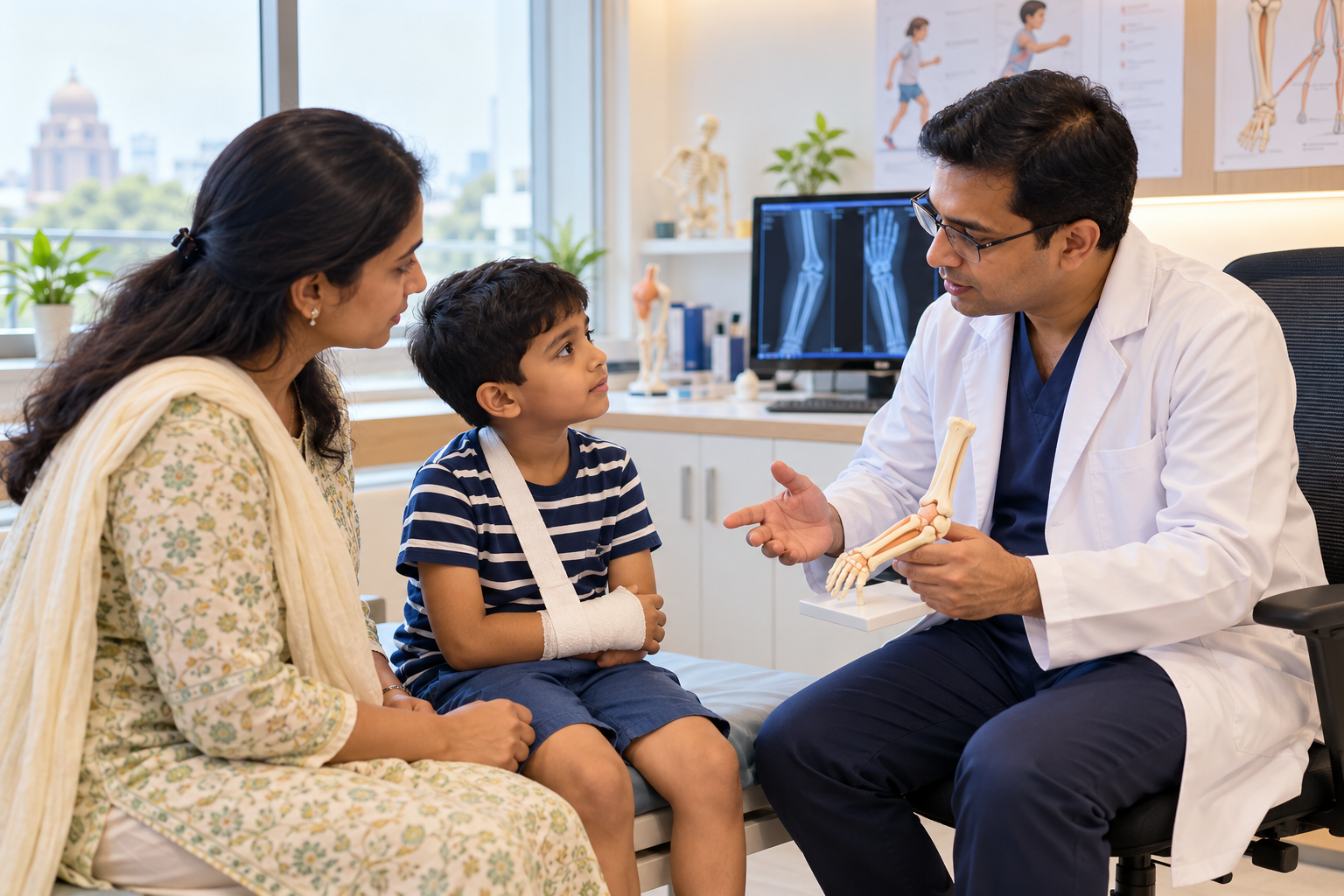
When a child falls while playing, the sound of the impact and the sight of them clutching their arm can send a wave of panic through any parent. In that moment, questions flood your mind: Is it broken? Do we need to rush to the hospital? Will my child need surgery? The treatment approach is distinctly different from that of adults. If you are searching for the best pediatric orthopedic doctor near me, understanding how these injuries are managed can help you feel more prepared and confident about the next steps.
What Is a Pediatric Fracture?
In simple terms, a fracture is a break or a crack in a bone. While the word “fracture” might sound serious, it is simply the medical term for a broken bone. Children’s bones are different from adults’ bones in both structure and how they break.
When a child suffers a fracture, the pattern of the break is often unique. Common fracture types in children include:
- Greenstick fractures: The bone bends and cracks on one side but does not break all the way through, similar to how a fresh green stick breaks. This is common because children’s bones are more flexible.
- Buckle (or Torus) fractures: The bone’s outer layer compresses and buckles, creating a small bulge or wrinkle in the bone. This is a very common and generally stable injury in young children.
- Complete fractures: The bone breaks all the way through. This can be further described as displaced (the bone ends are not aligned) or non-displaced (the bone ends remain aligned).
- Growth plate fractures: These involve the area of the bone responsible for growth (the physis). These injuries require careful evaluation and monitoring.
- Hairline or stress fractures: A thin crack in the bone, which can sometimes be difficult to see on an initial X-ray.
Why Are Children’s Fractures Different from Adult Fractures?
Children are not just small adults, and their bones reflect this. The unique characteristics of growing bones influence every decision a doctor makes regarding treatment.
- Greater Flexibility: Children’s bones are more porous and flexible, which allows them to bend and absorb shock better than adult bones. This is why incomplete fractures like greenstick and buckle fractures are common.
- Thicker Periosteum: The periosteum is a tough, fibrous layer covering the bone. In children, this layer is much thicker and more active, providing a rich blood supply that contributes to faster healing.
- Active Growth Plates: Growth plates (physes) are areas of cartilage near the ends of long bones where new bone is generated. Because these plates are the weakest part of the growing skeleton, they are vulnerable to injury. Any injury involving the growth plate must be managed carefully to avoid potential growth problems later.
- Ability to Remodel: Children’s bones have a remarkable capacity to remodel—meaning they can correct some degree of angulation or deformity as the child continues to grow. This is a key reason why some fractures that would require surgery in an adult can be treated with simple immobilization in a child.
These differences mean that a Pediatric Fracture Specialist is trained to consider not just the fracture itself, but also the child’s age, remaining growth potential, and how the injury might affect future development.
What Causes Fractures in Children?
Fractures in children typically result from common childhood activities. The mechanism of injury often determines the type and location of the fracture.
- Falls: This is the most common cause. Children can fall while running, playing, or climbing.
- Playground injuries: Falls from swings, slides, or monkey bars are frequent culprits.
- Sports injuries: High-impact sports like football, gymnastics, and skating can lead to fractures, especially in the arms and legs.
- Bicycle injuries: Falls from bikes often result in forearm or elbow fractures.
- Road traffic accidents: These tend to cause more severe injuries.
- Household accidents: Tripping over objects, falling from furniture, or injuries during play at home.
- Direct impact and twisting injuries: A direct blow or a sudden twist can cause a bone to break.
The specific pattern of the fracture whether it is a simple buckle or a more complex break often reflects the force and direction of the injury.
What Are the Common Signs of a Fracture in a Child?
Recognizing a fracture can be challenging, especially in younger children who may not be able to clearly describe their pain. Here are the common signs to watch for:
- Pain: Persistent pain, especially when moving the injured area or applying pressure.
- Swelling: Swelling around the injury site may develop quickly.
- Bruising: Discoloration may appear over the injured bone.
- Tenderness: Your child may cry or pull away when the area is gently touched.
- Difficulty using the limb: Your child may refuse to use their arm or leg, or they may limp.
- Abnormal movement: The limb may move in an unnatural way.
- Visible deformity: The limb may look bent or out of shape.
- Refusal to bear weight: A child with a leg fracture may refuse to stand or walk.
It is important to know that a child does not always need to have severe pain or an obvious deformity to have a fracture. Some fractures, particularly buckle fractures, may cause only mild discomfort. If you suspect any injury, it is always best to have it evaluated.
What Should Parents Do Immediately After a Suspected Fracture?
In the moments after an injury, your calm and quick actions can make a difference. Here is what you can do:
- Keep your child calm: Reassure them and keep them as still as possible.
- Do not move the injured limb: Avoid trying to examine the limb or move it unnecessarily.
- Support or immobilize the area: If you have a splint or can improvise one with a rolled-up magazine or a piece of cardboard, gently support the injured area in the position you found it. Do not attempt to straighten a visibly deformed limb.
- Apply a cold pack: Wrap an ice pack or a bag of frozen vegetables in a cloth and apply it to the area to help reduce swelling and pain.
- Avoid giving food or drink: If there is a possibility that urgent surgery may be needed, it is best to withhold food and drink until your child has been assessed by a doctor.
- Seek medical assessment: For any suspected fracture, take your child to a hospital emergency department or an urgent care center. For serious injuries such as an open fracture (where the bone is visible), severe bleeding, or a suspected head, neck, or spine injury call for emergency medical services immediately.
Remember, first aid is not a substitute for professional evaluation. A doctor needs to examine and X-ray the injury to determine the best course of action.
How Are Pediatric Fractures Diagnosed?
Accurate diagnosis is the first step toward effective treatment. A Pediatric Orthopedic Doctor in Bhubaneswar will follow a systematic approach.
Medical History
The doctor will ask questions to understand the injury:
- How and when did the injury happen?
- Where does your child feel pain?
- Can your child move the limb?
- Are there any previous injuries or medical conditions?
Physical Examination
A thorough examination will assess:
- Swelling and bruising
- Tenderness over specific areas
- Range of motion
- Alignment of the limb
- Circulation (pulses, warmth, color)
- Sensation and nerve function
Imaging
X-rays are the most common and effective way to diagnose a fracture. They can show the location and type of break. In some cases, the doctor may recommend:
- Ultrasound: Occasionally used in young children or for certain types of fractures to avoid radiation.
- CT scan: For complex injuries, particularly those involving joints.
- MRI: If a growth plate injury or a stress fracture is suspected and not visible on X-ray.
Not every child needs advanced imaging. The choice depends on the clinical findings and the specific injury.
How Are Pediatric Fractures Treated?
The treatment of a pediatric fracture is highly individualized. It depends on several factors, including the child’s age, the location and type of fracture, whether the bone has shifted, if the growth plate is involved, and the overall health of the child. The goal is to ensure proper healing, restore function, and minimize any impact on growth.
Not every pediatric fracture requires surgery. In fact, many can be treated successfully with non-surgical methods.
Observation
Some stable and minor injuries, such as certain buckle fractures, may simply require monitoring and symptomatic care, like pain relief and temporary activity restriction.
Immobilization
This is the most common treatment for many fractures. Immobilization protects the bone while it heals.
- Casts: A molded shell, usually made of plaster or fiberglass, that encircles the limb. Casts provide rigid support.
- Splints: A partial cast that supports the injured area but allows for some swelling. Splints are often used initially after an injury.
- Braces: In selected cases, a removable brace may be used to provide support while allowing some movement.
Closed Reduction
When a bone is displaced (the ends are not aligned), a doctor may perform a closed reduction. This involves gently realigning the bone fragments from outside the body, without making an incision. Appropriate pain control or anesthesia is used to ensure your child is comfortable during the procedure. Afterward, a cast or splint is applied to hold the bones in place.
Surgical Treatment
Surgery may be recommended for certain fractures. This is not a sign that the injury is “worse” than others; it simply means that surgery offers the best chance for optimal healing. Reasons for surgery include:
- The fracture is significantly displaced and cannot be adequately aligned or kept aligned without surgery.
- The fracture is unstable.
- The growth plate is significantly affected.
- The fracture extends into a joint.
- There is an open fracture (the bone has broken through the skin).
- There is associated damage to nerves or blood vessels that requires surgical repair.
Surgical options may include inserting metal pins, screws, or rods to hold the bones in place while they heal. These are often removed after healing is complete.
Follow-Up
Follow-up appointments are a crucial part of the treatment plan. During these visits, the doctor will:
- Check the alignment of the bones with X-rays.
- Monitor the healing process.
- Adjust or remove the cast or splint.
- Assess your child’s movement and function.
- Monitor for any growth-related concerns, especially after growth plate injuries.
For comprehensive Pediatric Fracture Treatment in Bhubaneswar, following the recommended follow-up schedule is essential for a successful outcome.
When Does a Child’s Fracture Need Surgery?
This is one of the most common questions parents have. The decision to operate is based on a careful evaluation of clinical and imaging findings. Surgery is typically considered when:
- The fracture is unstable and likely to shift out of alignment.
- The fracture is significantly displaced and cannot be corrected or maintained in a good position with a cast alone.
- The fracture involves a joint surface (intra-articular fracture).
- There is a growth plate injury that is displaced and requires precise realignment.
- The fracture is open (bone has penetrated the skin).
- The fracture cannot be maintained in an acceptable alignment through non-surgical means.
- There are associated injuries to nerves, blood vessels, or other structures that require surgical management.
It is important to emphasize: Not every displaced fracture requires surgery, and the decision must be individualized. A Pediatric Orthopedic Surgeon will weigh the benefits and risks of both surgical and non-surgical options to determine the best approach for your child.
What Are Growth Plate Fractures?
Growth plates (physes) are areas of specialized cartilage located at the ends of the long bones in children. They are responsible for the bone’s longitudinal growth—essentially, they are what make a child grow taller. These plates are the last part of the bone to harden (ossify) and are therefore the weakest. The Salter-Harris classification system is used to describe these injuries, ranging from Type I (fracture through the growth plate only) to Type V (crush injury to the growth plate).
How Long does a child fracture take to heal?
There is no single timeline for fracture healing. Healing time varies widely based on:
- The child’s age (younger children heal faster).
- The bone that is fractured.
- The type and severity of the fracture.
- The treatment method used.
- The child’s overall health.
As a general rule, children’s fractures tend to heal faster than adult fractures. A young child might heal from a simple fracture in as little as three to four weeks, while a teenager might take six weeks or more for a similar injury. The treating clinician will determine when it is safe for your child to resume normal activities based on X-ray evidence of healing and clinical examination.
What Happens After the Cast or Splint Is Removed?
Once the cast is removed, the bone may be healed, but the limb is not yet back to normal. It is common to experience:
- Stiffness: The joints may feel tight and difficult to move.
- Weakness: The muscles around the injured area may have weakened from disuse.
- Reduced movement: Your child may not be able to fully bend or straighten the limb at first.
- Mild discomfort: Some soreness is normal as your child begins to use the limb again.
Recovery from this stage depends on the injury. Many children naturally regain their movement and strength through everyday play and activities. In some cases, a doctor may recommend specific exercises or a short course of physiotherapy to help restore range of motion and strength. There is no standard rehabilitation plan for every child; it should be tailored to their individual needs.
Can Children’s Fractures Heal Completely?
The growing skeleton has a remarkable ability to heal and remodel. Many children recover fully from fractures without lasting problems. The bone can often correct mild degrees of angulation as it continues to grow.
However, complete healing depends on several factors, including:
- Appropriate fracture alignment.
- Proper and timely treatment.
- Regular follow-up to monitor healing.
- Adherence to activity restrictions.
- Monitoring for any growth-related issues.
While the vast majority of pediatric fractures heal well, some can have complications. Following your doctor’s advice and attending all follow-up appointments is the best way to support your child’s recovery.
Possible Complications of Pediatric Fractures
While complications are not inevitable, they can occur. The risk depends on the specific injury and how it is managed. Potential complications include:
- Delayed healing: The bone takes longer than expected to heal.
- Malalignment: The bone heals in a slightly incorrect position. In children, mild malalignment can often correct itself with growth, but more significant deformity may require intervention.
- Joint stiffness: This is common after prolonged immobilization but usually improves with time and activity.
- Infection: This is a risk primarily for open fractures or after surgery.
- Nerve or blood vessel injury: This can occur with certain fractures, particularly around the elbow or knee.
- Growth disturbance: This is a specific risk with growth plate fractures. It can lead to the bone growing at an angle or stopping growth prematurely.
- Re-fracture: In some cases, the bone may break again, especially if your child returns to high-impact activities too soon.
It is important to remember that complications are not inevitable and can often be minimized with proper treatment and follow-up.
When Should Parents Seek Urgent Medical Attention?
Some situations require immediate emergency care. Do not wait for a routine appointment. Seek urgent medical attention if your child has:
- An obvious deformity of a limb.
- Severe or uncontrolled pain.
- An open wound over the suspected fracture site.
- Significant bleeding.
- Numbness or loss of sensation in the limb.
- Fingers or toes that are pale, blue, or unusually cold.
- Inability to move the affected limb.
- Rapidly increasing swelling.
- Been involved in a serious accident (e.g., a car accident).
- A suspected injury to the spine, head, chest, or abdomen along with the fracture.
For any serious injury, it is always safer to go to an emergency department.
How Can Parents Help Their Child Recover?
You play a vital role in your child’s recovery. Here are some practical ways to help:
- Follow the doctor’s instructions: Adhere strictly to the treatment plan provided.
- Cast and splint care: Keep the cast or splint dry and intact. Follow the specific care instructions provided by your doctor.
- Attend all follow-up appointments: These are essential for monitoring healing and making timely adjustments to treatment.
- Activity restrictions: Prevent your child from returning to sports or rough play too early. Follow the doctor’s guidance on when it is safe to resume activities.
- Nutrition: Provide a balanced diet that supports bone health. While calcium and vitamin D are important, there is no special “fracture diet.” A normal, healthy diet is sufficient.
- Watch for concerning symptoms: Contact your doctor if you notice worsening pain, swelling, numbness, or changes in the color or temperature of the limb.
- Encourage normal activity when safe: Once the doctor gives the go-ahead, encourage your child to use the limb normally. This is often the best form of rehabilitation.
When Should You Consult a Pediatric Orthopedic Surgeon?
While many fractures can be managed by a general practitioner or in an emergency department, some situations benefit from the expertise of a Pediatric Orthopedic Surgeon in Bhubaneswar. You should consider a consultation if your child has:
- A suspected or confirmed fracture that requires specialized assessment.
- A fracture that involves the growth plate.
- A displaced or complex fracture.
- Recurrent fractures (fractures that happen easily or frequently).
- A fracture that extends into a joint.
- A fracture that has resulted in a deformity.
- An injury that requires specialized follow-up, such as a growth plate injury.
- Concerns about healing or a delayed return to activity.
If you are looking for the pediatric orthopedic expert , Take a consultation of a qualified specialist who can provide expert evaluation and care for your child’s fracture. You can learn more about his
Frequently Asked Questions
1. How are fractures treated in children?
Ans :- Treatment depends on the fracture type and location. Most are treated with immobilization using a cast or splint. Some may require a procedure called closed reduction to realign the bone. A smaller number require surgery.
2. Do all pediatric fractures need a cast?
Ans :- No. Some minor fractures, like buckle fractures, can be treated with a removable splint or even a supportive bandage. The choice depends on the stability of the fracture.
3. When does a child’s fracture need surgery?
Ans :- Surgery is considered for unstable fractures, fractures that are significantly displaced and cannot be kept aligned, open fractures, fractures involving a joint, and certain growth plate injuries.
4. How long does a child’s fracture take to heal?
Ans :- Healing time varies. Young children can heal in as little as three to four weeks, while teenagers may take six weeks or longer. The doctor will monitor healing with X-rays.
5. Are children’s fractures different from adult fractures?
Ans :- Yes. Children’s bones are more flexible, have thicker periosteum, and contain active growth plates. They also have a greater ability to remodel, which influences treatment decisions.
6. What is a growth plate fracture?
Ans :- A growth plate fracture is an injury to the area of the bone responsible for growth. These injuries need careful evaluation and monitoring to ensure they do not affect future bone growth.
7. Can a child walk with a fracture?
Ans :- It depends on the fracture. A child with a leg fracture may be unable to bear weight, but some stable fractures might allow for limited walking with support. It is best to have any suspected fracture evaluated before allowing your child to walk.
8. Does every child with a fracture need an X-ray?
Ans :- X-ray is the standard method for diagnosing most fractures. In some cases, especially in young children, an ultrasound may be used. Advanced imaging like CT or MRI is only used when clinically indicated.
9. When should a child see a pediatric orthopedic surgeon?
Ans :- A consultation is recommended for growth plate injuries, complex or displaced fractures, fractures that might require surgery, and any fracture that is not healing as expected.
10. What should I do if my child has a cast?
Keep the cast dry, check it regularly for damage, and follow your doctor’s instructions. Contact your doctor if you notice increasing pain, swelling, or any change in color or sensation in the fingers or toes.
Conclusion
A fracture in a child can be a stressful experience for the entire family. However, with appropriate care, most children recover fully. The key is to remember that children’s fractures require age-appropriate evaluation, as their growing bones have unique properties. Many fractures can be treated without surgery, using casts or splints. Some complex or unstable fractures may require surgical treatment to ensure the best possible outcome. If you are searching for the best pediatric orthopedic doctor near me, timely evaluation by a pediatric orthopedic specialist can help determine the appropriate treatment and follow up for your child
Worried About Your Child’s Injury? Don’t Wait to Get Expert Answers.
A child’s injury can be a scary moment for any parent. If you are searching for the best pediatric orthopedic doctor near me, timely evaluation matters. A pediatric orthopedic specialist can assess your child’s injury, provide a clear diagnosis, and recommend the right treatment. Delaying care may lead to complications. Book a consultation with Dr. Dibya Ranjan Sahoo for expert guidance and peace of mind.
Meet Your Pediatric Orthopedic Specialist Dr Dibya Ranjan Sahoo

Dr. Dibya Ranjan Sahoo is a Pediatric Orthopedic Surgeon based in Bhubaneswar. He evaluates back pain and musculoskeletal concerns in children, teenagers, and adults. Whether your pain is related to prolonged sitting, poor posture, sports strain, or pediatric orthopedic related situation, a proper assessment matters. Persistent, severe, or recurrent back pain should not be ignored. Book an orthopedic consultation to discuss your symptoms and receive appropriate, evidence-based care. Early evaluation helps identify the cause and guides the right treatment plan.
Book a Consultation with Dr Dibya Ranjan Sahoo
Dr Dibya Ranjan Sahoo Pediatric Orthopedic Doctor in Bhubaneswar
Address :- Pragati Enclave, MIG S 21, Niladri Vihar, Chandrasekharpur, Bhubaneswar, Odisha 751016.
Book an appointment today and get a consultation for back pain treatment
