

1. Persistent or Recurring Hip Pain
Occasional aches are common in growing children. But hip pain in children that continues for days, returns frequently, or interferes with normal activities—like playing, walking, or sleeping—warrants medical evaluation. Pain that wakes a child at night or pain that is not improving with rest should be discussed with a doctor.
2. Limping or a Noticeable Change in Walking
A new or persistent limp is one of the most common reasons parents seek orthopedic care. While some limps follow a minor injury and resolve on their own, a limp that has no obvious cause, continues for more than a few days, or is accompanied by pain should be assessed.
Parents may notice the child:
- Limping or favouring one leg
- Walking differently than usual
- Avoiding certain movements
- Having difficulty running
- Refusing to walk in younger children
A limp should not automatically be attributed to “growing pains.” If it persists, it needs professional evaluation.
3. Difficulty Moving One Leg or Reduced Hip Movement
Parents may observe that one leg is harder to move than the other. The child might resist having their legs spread apart during nappy changes, or they may seem stiff or reluctant to move one side. Asymmetry in movement—where one side moves differently from the other—can sometimes indicate an underlying hip issue and may warrant assessment.
4. Unequal Leg Movement or Apparent Leg-Length Difference
Some children appear to have one leg shorter than the other. This can sometimes be related to positioning, muscle tightness, or other factors—and it does not necessarily mean a true leg-length discrepancy exists.
However, if you notice a consistent difference in leg length, uneven skin creases on the thighs or buttocks, or one leg that turns outward more than the other, professional evaluation is recommended rather than self-diagnosis.
5. Clicking, Popping, or Unusual Hip Movement
Hearing a click or pop from a child’s hip can be alarming for parents. The truth is that some sounds occur without any serious problem. Many infants have “clicky hips” that resolve naturally.
However, when clicking or popping is accompanied by pain, limited movement, or changes in how the child walks or moves, it deserves medical attention. Persistent symptoms are the key concern—not every clicking sound means DDH.
6. Delayed or Abnormal Motor Development
Children develop at different rates, and there is a wide range of what is considered normal. That said, persistent difficulty with age-appropriate activities such as standing, walking, running, or climbing may warrant discussion with a pediatrician or orthopedic specialist.
Signs that may prompt evaluation include not sitting by ten months, not walking by eighteen months, or consistently walking on toes on one side only. Avoid comparing your child rigidly to milestone charts—but do trust your instincts if something feels persistently off.
7. Sudden Severe Pain, Inability to Walk, or Rapidly Worsening Symptoms
This is an important warning sign that requires prompt attention. If your child experiences sudden severe hip pain, cannot bear weight on one leg, has significant swelling, fever with joint pain, or appears acutely unwell, seek urgent medical assessment.
These symptoms could indicate conditions that need immediate attention, and they should not be managed at home with rest or painkillers alone. Do not attempt to diagnose the cause yourself—seek professional care.
Understanding Developmental Dysplasia of the Hip (DDH)
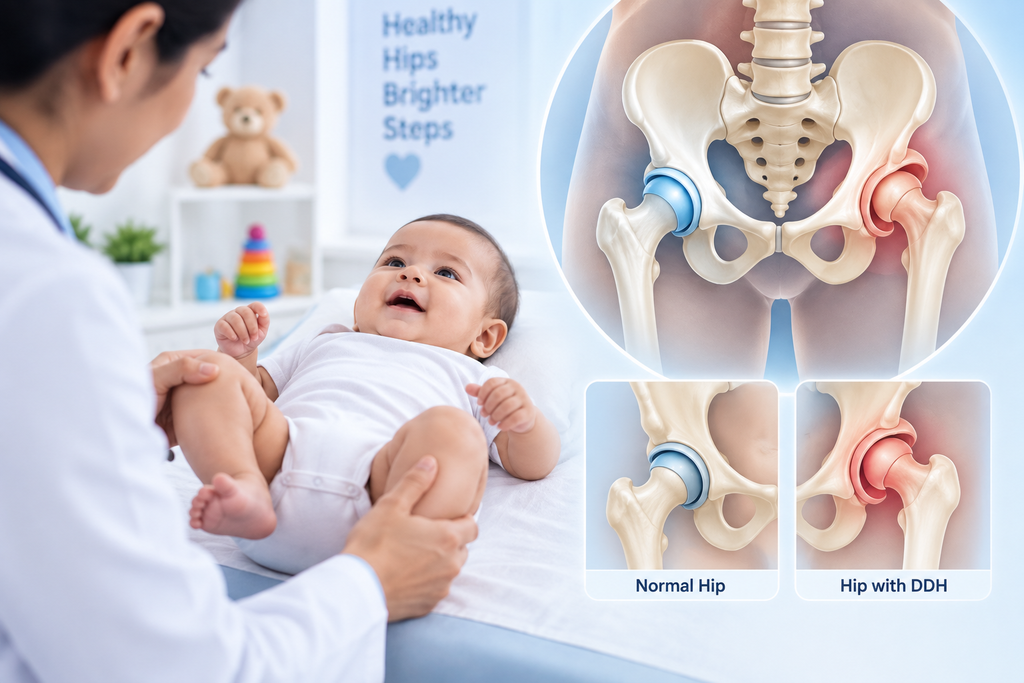
Developmental dysplasia of the hip is a condition where a baby’s hip joint does not grow normally. The hip joint consists of the femoral head (the ball at the top of the thigh bone) and the acetabulum (the cup-shaped socket in the pelvis). In DDH, the socket may be too shallow, or the ball may slip partially or completely out of position.
DDH is not always painful, and some babies show no obvious signs. When symptoms do appear, parents may notice uneven skin creases near the bottom, one leg that appears shorter, reduced movement on one side, or difficulty parting the legs for nappy changes. Once a child begins walking, a waddle or limp may become apparent.
Early recognition matters because treatment started in the first few months of life is often highly effective. Diagnosis requires professional assessment—parents cannot diagnose DDH at home. Doctors may evaluate suspected DDH through physical examination, ultrasound in younger infants, or X-rays in older children, depending on age and clinical findings. If you notice any of these signs, consulting a pediatric hip specialist in Bhubaneswar can help ensure your child receives timely evaluation and appropriate care.
How Are Hip Problems in Children Diagnosed?
A pediatric orthopedic evaluation typically includes:
- A detailed medical history
- Physical examination
- Assessment of walking and movement patterns
- Hip range-of-motion assessment
- Evaluation of leg alignment
- Ultrasound in appropriate infants
- X-rays when age-appropriate
- Other imaging when clinically indicated
The specific investigations depend on the child’s age and the suspected condition. For example, ultrasound is commonly used in infants under six months, while X-rays may be more informative in older children.
When Should Parents See a Pediatric Hip Specialist?
Professional evaluation is appropriate when a child has persistent hip pain, recurrent symptoms, limping, reduced hip movement, difficulty walking or running, developmental concerns, or suspected DDH. Symptoms following an injury, sudden severe symptoms, fever with joint pain, or inability to bear weight also require medical attention.
A pediatric hip doctor can assess these symptoms and determine whether further investigation or treatment is needed. In Bhubaneswar, families from Cuttack, Khordha, Puri, Jajpur, and Dhenkanal also have access to specialized pediatric orthopedic care.
Hip Problems vs Normal Childhood Aches
Children can experience occasional aches and minor injuries as they grow. Not every complaint requires specialist care. However, parents should pay attention to symptoms that are persistent, recurrent, getting worse, affecting walking or activity, associated with fever or illness, causing significant movement limitation, or causing the child to avoid using a leg.
The key distinction is between a temporary discomfort that resolves and a pattern of symptoms that interferes with daily life.
When Is Hip Pain an Emergency?
Seek urgent medical attention if your child has sudden severe hip pain, cannot walk or bear weight, has a significant injury, fever with severe joint pain, rapidly worsening symptoms, or appears seriously unwell along with joint symptoms. These situations require prompt assessment and should not be managed at home.
Frequently Asked Questions
1. What are the common hip problems in children?
Common hip problems include developmental dysplasia of the hip (DDH), transient synovitis, Perthes disease, hip pain from injury or overuse, and growth-related orthopedic conditions. The appropriate diagnosis depends on the child’s age and symptoms.
2. What are the warning signs of hip problems in children?
Persistent hip pain, limping, reduced hip movement, unequal leg movement, unusual clicking with pain, delayed motor development, and sudden severe symptoms are key warning signs.
3. What causes hip pain in children?
Causes can include injury, overuse, inflammation, developmental conditions like DDH, and growth-related changes. A medical evaluation helps identify the specific cause.
4. What is developmental dysplasia of the hip?
DDH is a condition where the hip joint does not develop normally, with the socket being too shallow or the ball slipping out of position. Early detection and treatment improve outcomes.
5. Can DDH be treated successfully?
When identified early, DDH can often be treated successfully with non-surgical methods such as bracing. Some cases may require surgery. Outcomes vary based on age at diagnosis and severity.
6. When should a child see a pediatric orthopedic doctor?
If your child has persistent hip pain, limping, reduced movement, or developmental concerns, a pediatric orthopedic evaluation is appropriate.
7. Is limping in a child always a sign of a serious hip problem?
No. Many limps are minor and resolve. However, a persistent or unexplained limp should be evaluated to rule out underlying conditions.
8. When is child hip pain an emergency?
Sudden severe pain, inability to bear weight, fever with joint pain, or rapidly worsening symptoms require urgent medical attention.
9. What does a pediatric hip specialist check during an examination?
A specialist assesses medical history, walking pattern, hip range of motion, leg alignment, and may recommend ultrasound or X-rays depending on the child’s age.
Conclusion
Most childhood hip symptoms are not emergencies, but persistent pain, limping, or movement changes deserve attention. Early evaluation by a qualified professional can provide clarity and guide appropriate care when needed.
Is Your Child Showing Signs of a Hip Problem?
If you have noticed persistent pain, limping, or unusual hip movement in your child, don’t wait for symptoms to resolve on their own. A professional assessment can help determine whether further investigation or treatment is needed. Consulting a pediatric hip specialist in Bhubaneswar ensures your child receives age-appropriate evaluation and guidance.
Meet Your Pediatric Expert: Dr. Dibya Ranjan Sahoo

Dr. Dibya Ranjan Sahoo is an Orthopedic Surgeon with MBBS, MS Orthopedics (AIIMS), DNB (Ortho), and a Fellowship in Pediatric Orthopedics. As Assistant Professor at KIMS Hospital Bhubaneswar, he brings specialized expertise in pediatric hip problems, limb length discrepancy, and complex pediatric orthopedic conditions, with a patient-centred approach to care.
Book Your Consultation Today And Get an Expert Treatment.
Dr. Dibya Ranjan Sahoo
MBBS, MS Orthopedics (AIIMS), DNB (Ortho) Fellowship in Pediatric Orthopedics , Assistant Professor, KIMS Hospital Bhubaneswar
Clinic Address :- Pragati Enclave, MIG S 21, Niladri Vihar, Chandrasekharpur, Bhubaneswar, Odisha 751016.
Visit Location: https://maps.app.goo.gl/451RtKtfnUhF9vJU6
Book an Appointment
Disclaimer :- The information provided in this blog is intended for general educational and informational purposes only. It is not intended to replace professional medical advice, diagnosis, or treatment from a qualified healthcare professional.
