
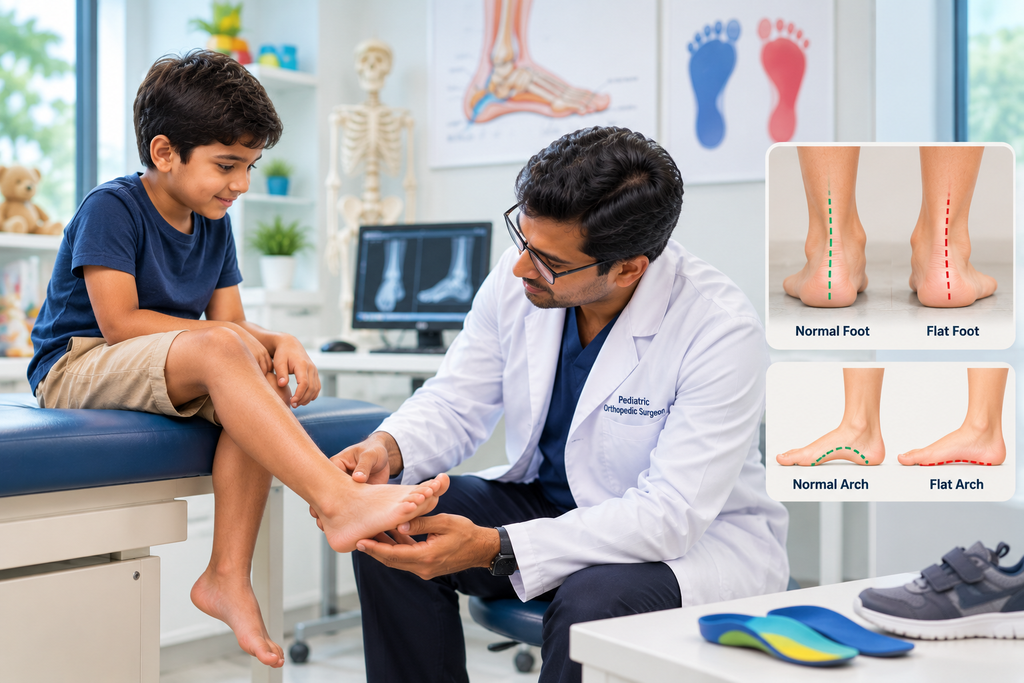
You notice that your child’s feet look flat when standing, or that the arches seem to disappear when your child puts weight on their feet. Does this mean something is wrong? In most cases, no. Flat feet in children are common, and they do not automatically indicate a problem. Parents often start by searching for Flat Feet Treatment in Bhubaneswar, but the more useful question is not whether a child has flat feet. It is whether the feet are painful, stiff, affecting movement or linked to another condition.
What Are Flat Feet?
Flat feet, also called pes planus, describe feet with a low or absent arch when standing. The arch is the curve along the inner side of the foot between the ball and the heel.
What the Arch Does
The arch helps the foot absorb shock, adapt to the ground and push off while walking and running.
What Happens When the Arch Looks Flat
When the arch appears flattened, more of the sole touches the ground. The heel may also tilt slightly outward.
Why Children’s Feet Look Different
Children’s feet have more soft tissue under the arch, and their ligaments are looser. The arch develops gradually during childhood, and there is no single age by which every child’s arch should appear.
Are Flat Feet Normal in Children?
Yes. Many young children naturally have low or apparently absent arches. In most cases this is a normal developmental variation.
Flexible Flat Feet
In flexible flat feet, the arch looks flat when the child stands but appears when the foot is unloaded or during certain movements.
How to Notice the Difference at Home
- The arch may appear when your child sits with feet hanging
- The arch may appear when your child stands on tiptoes
- The arch may appear when the big toe is gently lifted
These observations are general and do not replace a medical examination.
The Role of Age and Growth
Foot shape changes as a child grows. A foot that looks flat at one age may look different later.
Appearance Alone Does Not Decide Treatment
A flat-looking arch is not a reason for treatment by itself. What matters is how the foot works and whether it causes symptoms.
What Is the Difference Between Flexible and Rigid Flat Feet?
Doctors usually think of flat feet in four groups:
- Normal, developmental flexible flat feet
- Flexible flat feet with symptoms
- Rigid flat feet
- Flat feet associated with another orthopedic or medical condition
Quick Comparison Table Between Flexible and Rigid Flat Feet
| Feature | Flexible Flat Feet | Rigid Flat Feet |
| Arch | Flattens during standing | May remain flattened |
| Flexibility | Usually preserved | May be restricted |
| Pain | Often absent | May be present |
| Movement | Usually normal | May be limited |
| Treatment | Often observation if asymptomatic | May require evaluation |
| Follow-up | Depends on symptoms | More likely to require assessment |
Why Examination Matters
Only a clinical examination can tell which type a child has. Parents cannot reliably judge this from appearance alone.
What Causes Flat Feet in Children?
Several factors can contribute, and in most children the cause is simply normal development.
Common Factors
- Normal developmental variation
- Family tendency
- Ligament flexibility
- Foot and ankle alignment
- Muscle and tendon factors
Less Common Factors
- Certain structural foot conditions
- Previous injury in selected cases
- Neuromuscular or other medical conditions in uncommon cases
Keeping Rare Causes in Perspective
The less common causes are uncommon. Most children with flat feet have none of them, so a doctor looks at the whole picture rather than assuming a hidden condition.
What Are the Signs That Flat Feet May Be a Problem?
Most flat feet cause no symptoms. The signs below do not automatically mean flat feet are the cause, as many other conditions produce similar complaints.
Foot Pain
Pain in the foot or arch, especially if persistent or linked to activity, deserves attention.
Ankle Pain
Some children feel discomfort around the ankle, particularly after walking or play.
Heel or Leg Pain
Lower-limb discomfort has many causes and should not be automatically blamed on flat feet.
Difficulty Walking or Running
Reduced endurance or a change in activity levels may be worth noticing.
Frequent Fatigue
Persistent difficulty keeping up with other children may warrant assessment.
Uneven Walking
A limp or a difference between the two sides is worth checking.
Stiffness or Limited Movement
This is especially important when the foot looks rigid and does not form an arch in any position.
Difficulty Wearing Shoes
Persistent footwear problems, when linked to pain or visible deformity, should be assessed.
When Should Parents Be Concerned About Flat Feet?
Painless flexible flat feet often do not require treatment. Consider an evaluation if:
Pain and Function
- The child has persistent foot pain
- Pain limits sports or normal activities
- The child has difficulty walking or running
Shape and Movement
- One foot looks significantly different from the other
- The foot is stiff or rigid
- Foot shape is changing progressively
Other Warning Signs
- There is persistent swelling
- Symptoms develop suddenly
- Flat feet occur alongside another orthopedic or medical condition
How Does a Pediatric Orthopedic Surgeon Evaluate Flat Feet?
Evaluation starts with a conversation and an examination. Tests are added only when needed.
Medical History
The doctor may ask about:
- Pain and how long it has lasted
- Activity limitations
- Walking and running
- Previous injuries
- Family history
- Developmental history
Physical Examination
The doctor may assess:
- Foot shape and arch
- Heel alignment
- Ankle movement and flexibility
- Joint range of motion
- Muscle strength
- Walking pattern
- Ability to stand on the toes
- Overall limb alignment
The child may be observed sitting, standing and walking, because the foot can look different in each position.
When Do Flat Feet Need Treatment?
Many children with painless flexible flat feet do not need any treatment.
Situations Where Treatment May Be Considered
- Persistent pain
- Functional limitation
- Significant stiffness
- Structural abnormality
- Progressive deformity
- An underlying medical condition
The Child, Not the Arch
Treatment decisions are based on the child’s symptoms, flexibility, age, function and underlying cause, not just how the arch looks.
Flat Feet Treatment in Bhubaneswar: How Are Flat Feet in Children Treated?
Options range from simple monitoring to, rarely, surgery. Not every child needs any of them.
Observation
Flexible flat feet without symptoms may simply be monitored as the child grows.
Footwear
Comfortable, well-fitting shoes are generally important. Special shoes are not necessary for every child.
Orthotics
Arch supports or orthotic devices may sometimes be recommended for children with symptoms. They are not automatically required just because a child has flat feet.
Physiotherapy
Exercises or physiotherapy may be considered in selected children, particularly when flexibility, strength or movement patterns contribute to symptoms. There is no universal exercise program, so any plan should come from the treating team.
Activity Modification
Temporarily changing painful activities may sometimes be advised.
Surgery
Surgery is uncommon. It is generally reserved for selected children with significant, persistent symptoms or structural problems that do not improve with non-surgical care. It is never advised based on the look of the arch alone.
Do Children Outgrow Flat Feet?
Many children with flexible flat feet see their foot shape change as they grow. This is not the same for every child.
What to Keep in Mind
- Not every child’s arch develops in the same way
- Some children keep flexible flat feet without any symptoms
- Painful or rigid flat feet need evaluation
No Fixed Age
There is no guaranteed age by which all arches develop, so parents should focus on symptoms rather than a deadline.
Can Flat Feet Affect Walking or Running?
Painless flexible flat feet often do not interfere with normal activity. In some children, foot alignment may be associated with:
Possible Effects
- Changes in walking mechanics
- Fatigue
- Pain
- Reduced activity
- Difficulty with certain sports
A Note of Caution
Flat feet are not automatically the cause of every walking or leg problem. Other causes should be considered when symptoms persist.
Flat Feet and Sports
Many children with flat feet take part in sports normally. Children without symptoms generally do not need to stop.
When an Evaluation May Help
- Persistent pain during sports
- Repeated ankle problems
- Reduced endurance
- Difficulty running
- Symptoms that consistently limit participation
When Should You Consult Dr. Dibya Ranjan Sahoo for Flat Feet Treatment in Bhubaneswar?
Parents in Cuttack, Bhubaneswar and nearby areas may consider a pediatric orthopedic consultation if flat feet come with pain, stiffness, asymmetry, progressive change or difficulty with movement.
Choosing a Specialist
Families often look for a pediatric orthopedic surgeon in Bhubaneswar, a pediatric orthopedic doctor in Cuttack or a child foot specialist in Bhubaneswar when concerns continue. Dr. Dibya Ranjan Sahoo, Pediatric Orthopedic Surgeon, can evaluate children’s foot and orthopedic concerns and determine whether observation, supportive care or further investigation is appropriate. A pediatric foot specialist in Bhubaneswar can also explain whether a child’s feet are developing normally.
Frequently Asked Questions
1. Are flat feet normal in children?
Ans :- Yes. Flat feet are common in childhood, and most are flexible and painless. They are usually part of normal development.
2. At what age do children’s arches develop?
Ans :-There is no single age. Arches develop gradually and at different rates, so each child is different.
3. How can I tell if my child’s flat feet are a problem?
Ans :-Look for pain, stiffness, a foot that looks different from the other, difficulty walking or running, or changing foot shape. A doctor can confirm whether these signs matter.
4. Can children outgrow flat feet?
Ans :-Many children with flexible flat feet see their foot shape change with growth. Some keep flat feet without symptoms. Painful or rigid flat feet need evaluation.
Do flat feet cause pain in children?
Ans :-Often they do not. When pain does occur, flat feet are not always the cause, so other reasons should be considered.
Does every child with flat feet need treatment?
Ans :-No. Painless flexible flat feet often need only observation.
Do children with flat feet need special shoes?
Ans :-Not usually. Comfortable, well-fitting shoes are generally enough unless a doctor advises otherwise.
Can orthotics help children with flat feet?
Ans :-They may help some children with symptoms. They are not needed just because a child has flat feet, and the decision should come from a doctor.
When does a child need to see a pediatric orthopedic surgeon for flat feet?
Ans :-Consider a visit for persistent foot pain, a stiff or rigid foot, asymmetry, progressive change, sudden symptoms or difficulty walking or running.
Does flat feet treatment require surgery?
Ans :- Rarely. Surgery is reserved for selected children with significant, persistent symptoms that do not respond to non-surgical care.
Conclusion
Flat feet are common in childhood, and many children have flexible flat feet without pain or functional problems. A flat-looking arch alone does not mean treatment is needed. Pain, stiffness, asymmetry, progressive change or difficulty with movement deserve evaluation. For parents considering Flat Feet Treatment in Bhubaneswar, a pediatric orthopedic evaluation can clarify whether a child’s feet are developing normally, and whether any treatment is needed at all.
Worried About Your Child’s Flat Feet? Find Out Whether Flat Feet Treatment in Bhubaneswar Is Really Needed
Not every flat foot needs treatment, but a painful, stiff or changing foot should not be ignored. A proper examination gives clear answers and helps you avoid both unnecessary worry and unnecessary treatment.
Book a Professional Consultation With Dr Dibya Ranjan Sahoo

Dr Dibya Ranjan Sahoo Pediatric Orthopaedic Doctor in Bhubaneswar
Address :- Pragati Enclave, MIG S 21, Niladri Vihar, Chandrasekharpur, Bhubaneswar, Odisha 751016
Call :- +91 83288 83481
Visit Location :- https://maps.app.goo.gl/XzgXEJqorqeK7Vad8
Book an appointment today and get a professional consultation for your child flat feet treatment
