
“Is my child’s walking pattern normal?” , Will my child’s bow legs straighten on their own?” , “Should I be worried about how often she falls?” Parents ask these questions every day. You notice something small a slight limp, feet pointing inward, one leg that looks different from the other and you wonder: is this just a phase, or something more? Here’s the reassuring truth: many childhood musculoskeletal variations are simply part of normal growth and development. Children’s bones, joints, and muscles are continuously changing. What looks unusual at age two may resolve naturally by age six. But some problems need attention. Persistent pain, progressive deformities, or function-limiting symptoms may benefit from evaluation by a Pediatric Orthopedic Treatment in Bhubaneswar specialist who understands how growing bodies differ from adult ones.
What Does a Pediatric Orthopedic Surgeon Treat?
A pediatric orthopedic surgeon specializes in musculoskeletal problems in children—from newborns through teenagers. This includes conditions affecting:
- Bones
- Joints
- Muscles
- Tendons and ligaments
- Spine
- Feet and ankles
- Hips and knees
- Arms and legs
- Limb alignment
- Walking and gait
- Sports injuries
- Childhood fractures
- Growth-related problems
Treatment doesn’t always mean surgery. Depending on the diagnosis, a Pediatric Orthopedic Doctor in Bhubaneswar may recommend observation, physiotherapy, bracing, casting, or in selected cases, surgical intervention.
Does Every Child with an Orthopedic Concern Need Treatment?
No. This is one of the most important things for parents to understand. Pediatric orthopedic care does not automatically mean surgery or medication. The appropriate approach may be:
- Observation – Watching how a condition changes as the child grows
- Regular monitoring – Periodic check-ups to track progress
- Reassurance – Confirming that a variation falls within normal limits
- Activity modification – Reducing certain activities while healing occurs
- Physiotherapy – Addressing strength, flexibility, or movement issues
- Exercises – When clinically appropriate for specific conditions
- Bracing or orthotics – For selected cases where support is needed
- Casting – For certain fractures and conditions
- Surgery – Reserved for specific situations when other approaches aren’t appropriate
The right approach depends entirely on your child’s age, symptoms, physical examination findings, and diagnosis.
Signs That May Mean Your Child Should See a Pediatric Orthopedic Specialist
Persistent Pain
Ongoing bone, joint, muscle, or back pain deserves attention—especially if it interferes with sleep, play, school, or daily activities. Pain that worsens over time is particularly concerning.
Limping
A persistent or unexplained limp is never normal and should be evaluated . Some causes require prompt attention, while others may resolve with time and observation .
Walking Abnormalities
Pay attention to:
- Persistent toe walking beyond typical age
- Significant in-toeing or out-toeing
- Uneven walking pattern
- Difficulty walking or running
- Frequent tripping
Some gait variations are completely normal during development. Others may warrant assessment.
Repeated Falls
Frequent falls may warrant evaluation, particularly when accompanied by weakness, pain, coordination difficulties, or functional limitations.
Recurrent Fractures
Repeated fractures, or fractures following relatively minor trauma, may suggest an underlying condition that needs assessment.
Limb Deformity or Alignment Problems
This includes:
- Bow legs
- Knock knees
- Unequal leg length
- Abnormal limb alignment
- Visible deformity
Many alignment variations are normal at certain ages. For example, children are typically bowlegged at birth, become maximally knock-kneed around age three, and develop normal alignment by age eight .
Swelling or Restricted Joint Movement
Persistent swelling, stiffness, or limited movement in any joint should be evaluated.
Sports-Related Injuries
Injuries that don’t improve with rest, or that cause persistent pain, swelling, instability, or inability to return to normal activity, may need specialist evaluation.
Common Childhood Conditions That May Require Pediatric Orthopedic Evaluation
Pediatric Fractures
Children’s bones heal differently than adults. Most simple fractures heal well with casting, but some may involve the growth plate and require specialized care. Growth plate injuries can affect future bone growth if not managed appropriately .
Growth Plate Injuries
The growth plate (epiphysis) is the area of developing tissue near the ends of long bones. Injuries here are unique to children and require careful evaluation because they can affect limb growth .
Limb Deformities
Some limb differences are present at birth; others develop with growth. Evaluation helps determine whether a deformity is likely to self-correct or may need intervention.
Bow Legs (Genu Varum)
Most children have bow legs until around age two. This is a normal developmental stage . Persistent or worsening bow legs beyond age two, or bow legs affecting only one leg, may require evaluation.
Knock Knees (Genu Valgum)
Knock knees commonly appear between ages two and six and often improve naturally by age eight . Significant asymmetry or progression may warrant assessment.
In-Toeing
Most in-toeing resolves without treatment. A study of children referred for in-toeing found that 85% had a confirmed diagnosis, but none required casting or surgery—most were managed with counseling and observation . Severe cases may need specialist evaluation.
Out-Toeing
Like in-toeing, many cases of out-toeing are normal developmental variations. Persistent or asymmetric out-toeing should be evaluated.
Toe Walking
Idiopathic toe walking is common in young children. Most cases resolve without intervention. Persistent toe walking beyond age three to five, or toe walking associated with other symptoms, may need evaluation .
Gait Abnormalities
Any persistent walking pattern that concerns you deserves a professional opinion. Gait analysis and physical examination help determine whether observation or treatment is appropriate.
Flat Feet (Symptomatic or Functionally Significant)
Flexible flat feet are common and usually painless. Symptomatic flat feet those causing pain, difficulty with activities, or significant functional limitation—may benefit from evaluation.
Sports Injuries
Young athletes can experience injuries to ligaments, tendons, and growth areas. When pain, swelling, or instability persists despite rest, specialist evaluation helps guide return to activity.
Hip Problems
Conditions like developmental dysplasia of the hip (DDH) require early detection. Treatment outcomes are significantly better with early intervention . Any concern about hip development should be evaluated promptly.
Foot and Ankle Problems
Persistent foot or ankle pain, deformity, or difficulty walking should be assessed.
Persistent Musculoskeletal Pain
Pain that lasts more than a few weeks, worsens, or affects function deserves evaluation.
Limb-Length Differences
Leg length discrepancies can affect gait, posture, and function. Evaluation helps determine whether monitoring or treatment is appropriate.
When Should Parents Wait and When Should They Seek Evaluation?
| Situation | General Approach |
|---|---|
| Mild, short-lived discomfort after activity | Monitor if improving |
| Normal developmental variation | Observation may be appropriate |
| Persistent pain | Consider medical evaluation |
| Recurrent fractures | Specialist evaluation may be appropriate |
| Persistent limp | Medical evaluation |
| Progressive deformity | Orthopedic evaluation |
| Significant walking difficulty | Orthopedic evaluation |
| Major injury with deformity | Urgent medical assessment |
| Loss of previously acquired function | Prompt medical assessment |
This table provides general educational guidance and does not replace clinical assessment.
When Is Pediatric Orthopedic Treatment Urgent?
Seek emergency medical care for:
- Severe injury
- Obvious deformity after trauma
- Suspected fracture
- Open wound over a suspected fracture
- Severe, uncontrolled pain
- Rapidly increasing swelling
- Numbness or loss of sensation
- Pale, blue, or unusually cold fingers or toes
- Inability to use the injured limb
- Sudden inability to walk
- Significant injury involving the spine or head
These situations require immediate attention—not a scheduled appointment.
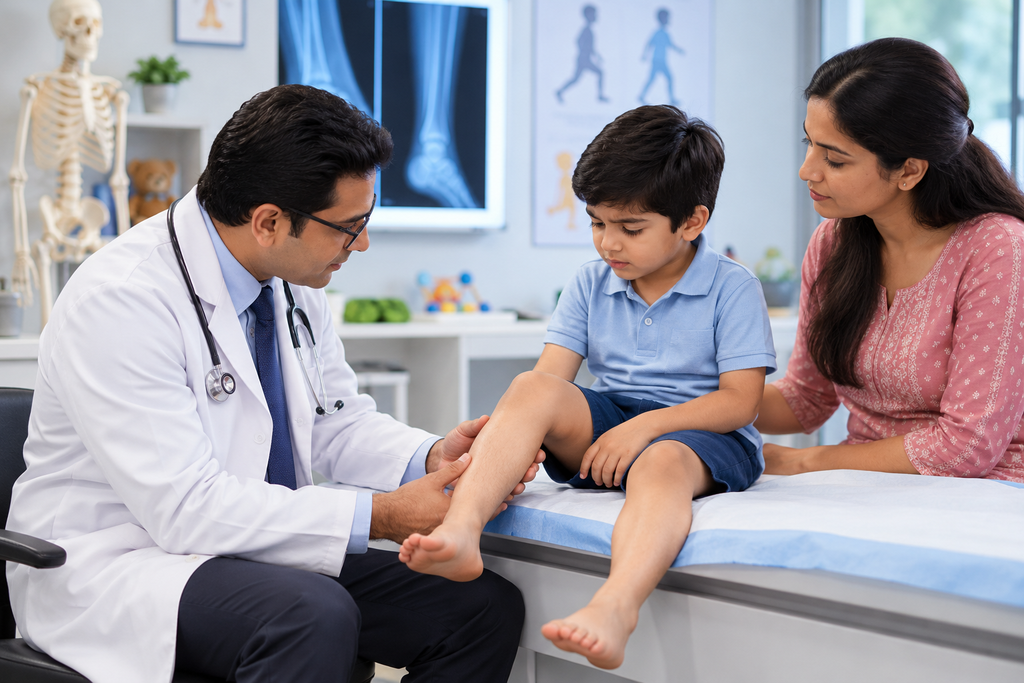
What Happens During a Pediatric Orthopedic Consultation?
Step 1: Medical History
The doctor will ask about symptoms, when the problem started, whether it’s improving or worsening, previous injuries, developmental history, activity level, and family history where relevant.
Step 2: Physical Examination
The assessment may include:
- Walking pattern observation
- Limb alignment
- Joint movement
- Muscle strength
- Flexibility
- Spine examination
- Hips, knees, ankles, and feet
- Limb length
- Neurological function when appropriate
Step 3: Imaging or Tests
X-rays or other investigations may be ordered when clinically indicated. Not every child requires imaging—the decision is based on examination findings.
Step 4: Treatment Plan
The doctor will discuss whether your child needs:
- Observation
- Follow-up visits
- Physiotherapy
- Orthotic support
- Casting or bracing
- Further investigation
- Surgery in selected cases
What Factors Determine Whether a Child Needs Treatment?
Pediatric orthopedic decisions are individualized. Factors include:
- Age
- Growth stage
- Severity of the condition
- Symptoms
- Functional impact
- Duration
- Progression
- Alignment
- Injury mechanism
- Imaging findings when available
- Overall health
The same physical finding may be managed differently in a two-year-old compared to a ten-year-old. Growth potential changes everything.
Can Children Outgrow Orthopedic Problems?
Some conditions improve naturally with growth. Others persist or worsen.
Examples of variations that often improve:
The decision to observe versus treat depends on your child’s individual development and clinical findings. No one can promise that a condition will resolve on its own.
Non-Surgical Pediatric Orthopedic Treatments
Observation and Follow-Up
For conditions that may change naturally with growth.
Physiotherapy
For selected problems involving strength, flexibility, movement, or rehabilitation.
Bracing or Orthotics
For specific conditions where clinically appropriate.
Casting
For certain fractures and orthopedic conditions.
Activity Modification
For selected injuries and sports-related problems.
When Is Surgery Considered?
Surgery is not the first option for most pediatric orthopedic conditions. It may be considered for:
- Certain severe deformities
- Some complex fractures
- Selected growth plate or joint injuries
- Conditions causing significant functional problems
- Problems that don’t respond to non-surgical management
Surgical decisions depend on diagnosis, age, growth potential, severity, and other clinical factors.
Why Is Pediatric Orthopedic Care Different from Adult Orthopedics?
Children are not small adults. Key differences include:
- Growth plates – Unique structures that need special consideration
- Bone remodeling – Children’s bones can reshape over time
- Developmental stages – What’s normal at one age may be abnormal at another
- Future growth – Treatment must account for how the child will grow
- Communication – Examination and explanation must be adapted for children
What Should Parents Bring to an Orthopedic Consultation?
- Previous medical reports
- X-rays or scans if available
- Details of previous injuries
- List of medications if relevant
- Information about when symptoms started
- Videos of unusual walking or movement patterns when appropriate
- Questions or concerns you want addressed
Frequently Asked Questions
1. When does a child need to see an orthopedic doctor?
Ans :- When there is persistent pain, a limp that doesn’t resolve, progressive deformity, recurrent fractures, or any symptom that limits your child’s normal activities. When in doubt, an evaluation provides clarity.
2. What problems does a pediatric orthopedic surgeon treat?
Ans :- Bone, joint, muscle, tendon, and ligament problems in growing children including fractures, gait abnormalities, limb deformities, sports injuries, and developmental conditions.
3. Does every child with bone pain need orthopedic treatment?
Ans :- No. Many causes of bone pain in children are temporary and resolve without treatment. Persistent, worsening, or function-limiting pain should be evaluated.
4. When should a child’s walking problem be evaluated?
Ans :- If a walking pattern is persistent, asymmetric, worsening, or associated with pain, weakness, or frequent falls, evaluation is appropriate.
5. children outgrow orthopedic problems?
Ans :- Some do particularly certain alignment variations and gait patterns. Others don’t. Only a clinical evaluation can determine which category applies to your child.
6. When does a child need orthopedic surgery?
Ans :- Surgery is considered for specific situations: certain severe deformities, complex fractures, selected growth plate injuries, or conditions that don’t respond to non-surgical treatment.
7. Can pediatric orthopedic problems be treated without surgery?
Ans :- Yes. Many conditions are managed with observation, physiotherapy, bracing, casting, or activity modification.
Should recurrent fractures in a child be evaluated?
Ans :- Yes. Repeated fractures, or fractures from minor trauma, warrant assessment for underlying conditions.
8. When should parents worry about bow legs or knock knees?
Ans :- Bow legs beyond age two, knock knees beyond age eight to ten, asymmetric alignment, or progression over time warrant evaluation.
9. What happens during a pediatric orthopedic consultation?
Ans :- A typical visit includes medical history, physical examination, possibly imaging, and a discussion of treatment options which may include observation.
Conclusion
Not every orthopedic concern requires treatment. Many childhood musculoskeletal variations are part of normal growth and development. However, persistent, painful, progressive, or function-limiting problems deserve evaluation. A Pediatric Orthopedic Surgeon in Bhubaneswar considers your child’s age, growth, and development when making treatment decisions. Treatment can range from observation and physiotherapy to casting, bracing, or surgery when clinically necessary. The right approach depends on accurate diagnosis and individualized assessment.
Is Your Child’s Walking, Alignment, or Pain Concern Worth an Evaluation?
If you’ve been watching your child’s gait, worrying about a limp, or wondering whether a deformity will correct itself, you deserve clear answers not guesswork. A Pediatric Orthopedic Treatment in Bhubaneswar can help determine whether observation, treatment, or further investigation is appropriate. if you are concerned about your child’s bones, joints, walking pattern, limb alignment, recurring injuries, or persistent pain, a pediatric orthopedic evaluation can help determine whether observation, treatment, or further investigation is appropriate.
Meet Your Pediatric Orthopedic Specialist Dr Dibya Ranjan Sahoo

Dr. Dibya Ranjan Sahoo is a Pediatric Orthopedic Surgeon based in Bhubaneswar. He evaluates back pain and musculoskeletal concerns in children, teenagers, and adults. Whether your pain is related to prolonged sitting, poor posture, sports strain, or pediatric orthopedic related situation, a proper assessment matters. Persistent, severe, or recurrent back pain should not be ignored. Book an orthopedic consultation to discuss your symptoms and receive appropriate, evidence-based care. Early evaluation helps identify the cause and guides the right treatment plan.
Book a Consultation with Dr Dibya Ranjan Sahoo
Dr Dibya Ranjan Sahoo Pediatric Orthopedic Doctor in Bhubaneswar
Address :- Pragati Enclave, MIG S 21, Niladri Vihar, Chandrasekharpur, Bhubaneswar, Odisha 751016.
Book an appointment today and get a consultation for back pain treatment
