
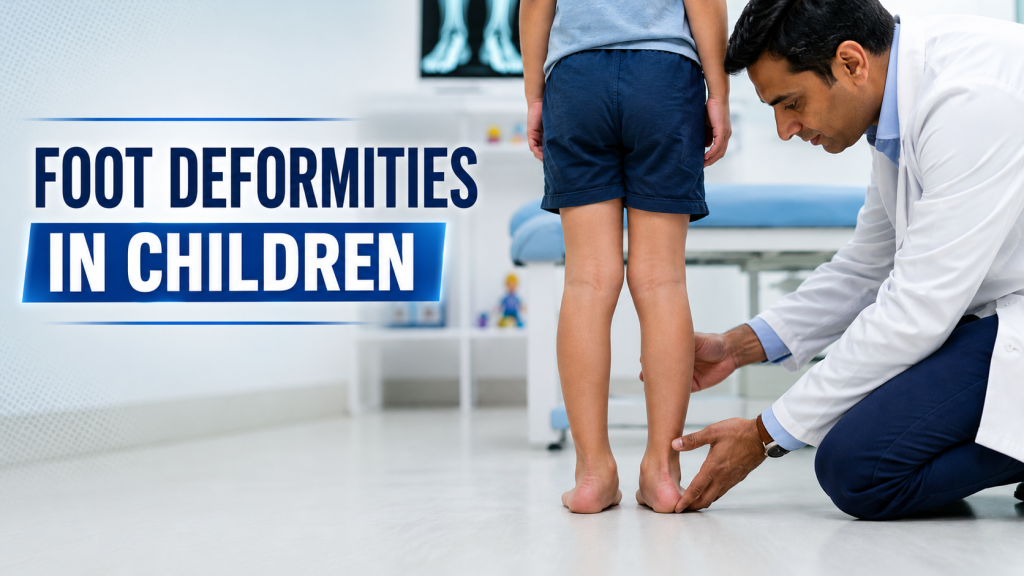
It was an ordinary evening at the park. Meera sat on a bench, watching her three-year-old son run after a football, when something caught her eye. His feet were turning inward with almost every step, and every so often, he tripped over his own toes. She brushed it off at first children fall all the time, don’t they? But when a relative mentioned it a few weeks later, that quiet worry returned. Was this simply how he walked at this age, or was something else going on?
Many parents in find themselves in Meera’s shoes at some point noticing a toddler’s feet turning in, a child hesitant to run with friends, or shoes wearing out unevenly at the edges. It is one of the most common concerns raised during pediatric visits, and it is completely natural to wonder what it means, and where to turn for reliable foot deformities treatment in Bhubaneswar.
Foot deformities in children are structural or functional differences in the shape, alignment or movement of the feet that go beyond the usual range of growth. The reassuring part of this story is that many of these variations are simply chapters in a child’s normal development, ones that resolve quietly on their own. Others, however, are worth a closer look, and knowing the difference is what this article sets out to help with.
Here, we walk through the common types of child foot deformities, why they happen, the signs that deserve attention, and how they are usually assessed and treated by a pediatric orthopedic specialist offering foot deformities treatment.
What Are Foot Deformities in Children?
To understand Meera’s situation, it helps to first understand what a foot deformity actually is. In simple terms, it is any structural change in the bones, joints, muscles or ligaments of the foot that affects how it looks or functions. But here is where many parents go wrong they assume that anything unusual-looking must be a problem. In reality, a child’s feet are still a work in progress. Features like flexible flat feet or a mildly inward step are often just part of the story of growing up, not a diagnosis.
The real distinction lies between a normal developmental variation, which tends to correct itself with time, and a genuine structural problem, which may persist, worsen, or begin to interfere with how a child walks, runs or plays. Telling these two apart is exactly what a paediatric orthopaedic specialist is trained to do, through careful examination rather than a quick glance.
Common Types of Foot Deformities in Children
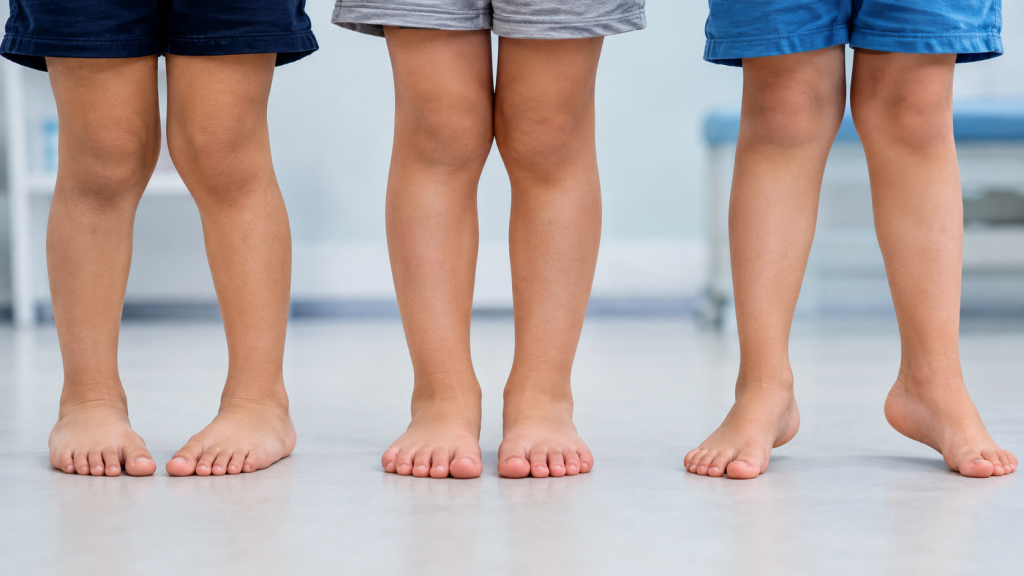
One of several common foot deformities in children that pediatric specialists see regularly. Let’s walk through each of them.
Clubfoot
For some families, the story begins right at birth. Clubfoot, medically known as congenital talipes equinovarus, is a condition where the foot turns inward and downward, affecting one or both feet. Clubfoot in children is usually spotted by pediatricians within the first days of life. Unlike some milder variations, it does not correct itself with time. Treatment typically begins early, most often with gentle stretching and casting, gradually guiding the foot into a better position over the first several months.
Flat Feet
Perhaps the most familiar story of all is flat feet in children. Here, the arch of the foot appears low or missing, particularly when the child is standing. For most toddlers, this is simply flexible flat feet, a normal stage that gradually gives way to a visible arch as the child grows. Only when the flat feet are rigid, painful, or clearly affecting how a child walks does a closer evaluation become necessary.
In-Toeing
This is the chapter Meera found herself reading. In-toeing in children, often described as walking “pigeon-toed,” happens when the feet turn inward with each step. It can trace back to the position of the thigh bone, the shin bone, or the foot itself. The reassuring twist in this story is that in-toeing is extremely common in toddlers and, in most cases, quietly resolves by the time a child reaches early school age, without any treatment at all.
Out-Toeing
Less commonly told, but still worth mentioning, is out-toeing where the feet point outward rather than inward. It is often linked to hip or leg rotation and, much like in-toeing, tends to improve naturally over time. If it persists or looks noticeably different between the two feet, it is worth bringing up with a specialist.
Bowed or Abnormal Foot Alignment
Many toddlers pass through a phase of bowed legs, particularly before the age of two, and this too usually straightens out on its own as part of normal growth. The plot only changes if the bowing is one-sided, appears to be getting worse, or comes with pain signs that are best discussed with a specialist rather than left to resolve quietly.
High-Arched Feet
On the opposite end of the spectrum from flat feet is pes cavus, or a high arch. This variation can sometimes be connected to underlying muscle or nerve conditions, so when a high arch persists alongside foot pain or repeated ankle sprains, it is generally worth having it evaluated.
Curly Toes or Overlapping Toes
Many babies are born with toes that curl under or cross over their neighbours, and in most cases, this is simply a passing feature that straightens out once the child begins walking regularly. It becomes a different story only when the overlapping causes discomfort, skin irritation, or trouble fitting into shoes.
What Causes Foot Deformities in Children?
Every child’s story is different, and so are the causes of foot deformities in children. Some of the possible threads include:
- Genetics – Certain conditions, including clubfoot, can run in families.
- Normal developmental growth patterns – Many variations are simply a stage in how bones and joints mature over time.
- Abnormal bone or joint development – Differences in how the foot’s structures form, either before or after birth.
- Muscle or tendon imbalance – Uneven pull between muscles that can subtly shift foot position.
- Neuromuscular conditions – Underlying nerve or muscle disorders that influence foot shape and movement.
- Conditions present from birth – Some deformities are congenital and identified soon after delivery.
- Previous injury – In certain cases, an earlier injury to the foot or ankle plays a role in altered alignment.
There is rarely a single, one-size-fits-all explanation. The cause is always specific to the child, which is exactly why a proper assessment matters more than guesswork.
Signs Parents Should Not Ignore
Not every unusual step is cause for concern, but every parent’s story deserves attention when certain signs appear:
- Persistent foot or leg pain
- Noticeable limping
- Frequent tripping or falling
- Difficulty running or keeping up with other children during play
- One foot looking clearly different in shape or size from the other
- A deformity that seems to be getting worse over time
- Difficulty fitting into regular children’s footwear
- A child avoiding walking, running or physical activity altogether
If any of these sound familiar, it is best not to let the story unfold further without a professional opinion.
How Are Foot Deformities Diagnosed?
When a parent does bring their child in, the diagnosis of pediatric foot problems unfolds step by step rather than through a single test. It typically involves:
- A detailed medical and developmental history
- A physical examination of the feet, legs and joints
- Observing how the child walks, sometimes called a gait assessment
- Assessing the overall alignment of the foot and leg
- X-rays or other imaging, but only when clinically necessary
Not every child needs an X-ray. In many cases, a careful clinical examination tells the whole story, with imaging reserved for situations where the diagnosis is unclear or treatment planning calls for it.
Treatment for Foot Deformities in Children
There is no single ending to this story. Treatment for foot deformities in children depends entirely on the child’s age, the severity of the condition, any accompanying symptoms, and the underlying cause. Depending on what the assessment reveals, a specialist may suggest:
- Observation and regular monitoring, for conditions likely to improve naturally with growth
- Stretching and exercises, when appropriate for the specific condition
- Physiotherapy, to build strength and support movement
- Special footwear or orthotics, in selected cases where they may genuinely help
- Casting or bracing, particularly for conditions such as clubfoot
- Surgical correction, reserved for specific severe or persistent deformities that do not respond to other approaches
Not every child needs footwear inserts, bracing or exercises. These should only feature in the story when a specialist has recommended them after a proper assessment. Families searching for foot deformities treatment in Bhubaneswar will find that a proper diagnosis always comes before any of these steps.
When Should Parents See a Pediatric Orthopaedic Specialist?
Meera’s story eventually led her to a specialist’s clinic, and that turned out to be the right next chapter. As a general guide, it is advisable to seek an opinion if a foot deformity was noticed at birth, if a variation is not improving with age, if there is pain, limping or difficulty with everyday activities, or simply if uncertainty remains about whether what you are seeing is normal. An early visit can either bring reassurance or set the stage for timely treatment. For parents based in and around the city, seeking foot deformities treatment in Bhubaneswar from a qualified pediatric orthopedic specialist is a sensible first step.
Frequently Asked Questions
Can children’s foot deformities correct themselves?
Certain conditions, such as flexible flat feet and mild in-toeing, often improve naturally as the child grows. Others, such as clubfoot, generally need early treatment.
When should a child with flat feet be evaluated?
Evaluation is generally recommended if the flat feet are rigid, painful, or affecting the child’s walking or activity levels, rather than for flexible flat feet alone.
Does clubfoot require treatment?
Yes. Clubfoot does not usually correct on its own and typically needs early intervention, most often gentle stretching and casting, sometimes with further treatment as the child grows.
Where can I find reliable foot deformities treatment in Bhubaneswar?
Parents in Bhubaneswar can consult a qualified paediatric orthopaedic specialist for a proper assessment before starting any treatment, since the right approach depends entirely on the individual child’s condition.
Conclusion
Every child’s feet tell a slightly different story as they grow some chapters resolve quietly on their own, while others benefit from a specialist’s guidance along the way. The most important thing for any parent to remember is not to write the ending themselves based on appearance alone. A professional assessment can help separate what is simply part of growing up from what may need monitoring or treatment. Like Meera discovered, an early evaluation often brings peace of mind, and for families seeking foot deformities treatment in Bhubaneswar, it can make a real difference to a child’s comfort and mobility as their story continues to unfold.
This article is for general educational information only and does not replace an in-person examination by a qualified paediatric orthopaedic specialist. If you have concerns about your child’s feet or walking pattern, please consult a specialist for personalised advice.
Dr Dibya Ranjan Sahoo
Pediatric Orthopedic Specialist
Pragati Enclave, MIG S 21, Neeladri Vihar, Chandrasekharpur, Bhubaneswar, Odisha 751016
Mail :- dibya.utkalorthocare@gmail.com
Call :- +91 83288 83481
Discalimer :- The information provided in this blog is intended for general educational and informational purposes only. It is not intended to replace professional medical advice, diagnosis, or treatment from a qualified healthcare professional.
